 Mr Viral
As energy prices continue to fluctuate and severe weather events become more frequent, the argument for home battery storage has never been stronger. This shift has been accelerated by the Federal Government’s ‘Cheaper Home Batteries Program‘, which launched in July 2025.
By extending the Small-scale Renewable Energy Scheme (SRES) to cover storage, the program effectively cuts the upfront cost of a battery by around 30%. The scheme has been incredibly popular, driving a record-breaking surge in installations, as homeowners move to reduce their reliance on the grid and exposure to energy prices. It is forecast that the number of applications for home storage battery rebates will hit 175,000 by the end of 2025.
For many Australian homeowners, the dream is simple: install solar, add a battery, and enjoy energy independence. However, the reality of getting a battery installed is often far more complex than just bolting a box to the wall.
Below is a checklist created by Tom from the Tesla Tripping blog, which will help to ensure that adding a battery to your home solar setup will actually deliver on the promise of energy security.
Having gone through this process twice now, at two different properties, there are a number of valuable lessons learned along the way. If you are about to sign a contract for a battery, you need to ensure your installer commits to specific deliverables in writing.
– Advertisement –
The 5 non-negotiables for your battery install
It is easy to assume that adding a battery at home will just back everything up, but that is rarely the default configuration. To avoid disappointment during your first blackout, it is suggested that you get your installer to agree to the following five points.
1. Remote control and monitoring
You need full visibility over your investment, which means a robust app or website interface is mandatory. This software should allow you to monitor power flow between your battery, house, and the grid in real-time. You also need access to historical data to understand your usage patterns over days, weeks, and months.
Crucially, you must have the ability to set a “minimum charge percentage” or reserve limit at any time. This ensures that if you know a storm is coming, you can force the battery to hold a 100% charge in preparation. Without this feature, you might enter a blackout with an empty battery simply because you used the power earlier in the evening.
2. Comprehensive backup coverage
During a grid outage, the battery should switch over automatically to power your home. Your installer must test this functionality on the day of installation and demonstrate it to you. Ideally, the battery should power your entire home, up to the hardware’s maximum output limit.
For many standard batteries like a Tesla Powerwall, this is usually around 5kW of continuous power. If you have three-phase power, be aware that many batteries can only back up a single phase, which is a critical detail to clarify upfront. You need to know exactly which circuits will stay on and which will go dark.
3. Solar continuity during outages
This is the most common nasty surprise for battery owners during a blackout. You must ensure that during a grid outage, your solar panels continue to operate and recharge the battery. If your system isn’t configured correctly, the solar inverter may shut down for safety when the grid goes down, leaving you with a finite amount of battery power.
Your solar generation should continue to operate at the full capacity that your house and battery can absorb. It should not be artificially restricted to just a few panels, as this severely hampers your ability to survive multi-day outages. You want to capture every bit of sunlight possible when the grid is down.
4. Export curtailment capabilities
With the rise of “negative feed-in tariffs,” there are times when the grid is so flooded with solar that you might be charged to export power. You need a system that has the ability to curtail or stop exporting power to the grid when pricing is negative. This feature protects your energy credits and ensures you aren’t paying for the privilege of giving away your power.
5. Compatibility with smart retailers
Even if you are with a standard retailer now, you want hardware that is compatible with dynamic retailers like Amber Electric. Amber allows you to access wholesale energy prices, which can significantly accelerate the payback period of your battery. With a compatible battery, you can tell the Amber app to automate your battery import and export to maximise your profits in the wholesale energy market.
Lessons from the field
To highlight why these questions matter, let’s look at my previous setup in Saratoga, NSW. We installed an 8kW solar system paired with a 13.5kWh Tesla Powerwall 2 on a property with three-phase power. When a blackout hit, the battery kicked in instantly, making us the only house on the street with the lights on.
It successfully powered our lights, fridge, microwave, and general power points. However, because of the three-phase limitation, we had to exclude significant appliances from the backup loops. We requested that the battery connect to specific essential circuits, but we had to accept that not everything could run.
We could not back up the upstairs ducted air conditioning or the electric oven and stovetop. We also had to exclude the EV charger, as the load would have been too high for the single-phase backup. Even with those exclusions, we felt relatively secure until we realised the system’s biggest flaw.
The biggest failure of this system was that our solar panels and inverter would shut down during a grid outage. Even with plenty of sunlight, the solar system would not power the house or recharge the battery. This meant that our backup was only good for a few hours, depending on how much charge the battery had when the outage started.
In our case, this limitation was because our solar system was three-phase, but our battery was only single-phase. The limitation was not properly explained to us prior to installation. Even on a single-phase system, some battery installations are not designed or installed to provide backup power to all needed circuits, or to facilitate continued solar production during a grid outage.
Getting it right
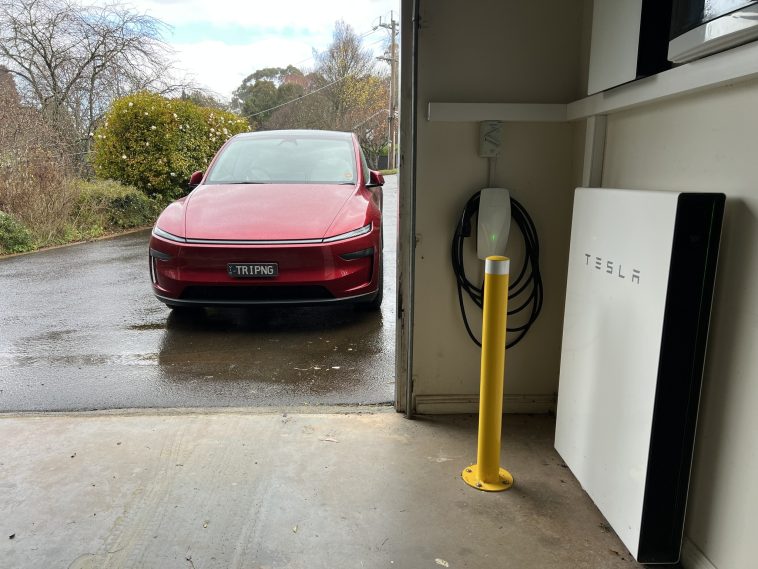
Moving to our current home in Emerald, Victoria, I was determined not to make the same mistakes. We installed 12kW of solar panels, a 10kW inverter and a Tesla Powerwall 2 13.5kWh battery. Crucially, we have single-phase power at this property.
I specifically requested that all circuits be connected to backup. This included: all power points and lights; our split air conditioner; water pump; oven; hot water heat pump; and even our EV charger. This design was intended to provide a true whole-home backup experience.
The ultimate test: A nine-day blackout
Living in the Dandenong Ranges, we are no strangers to storms, and we recently endured a massive nine-day grid outage. When it first started, we were away on a road trip, but the Tesla app notified us that the grid outage was slowly draining our battery. To our horror, we saw it was not recharging from solar.
We learned the hard way that we should have tested our system with an outage immediately after installation. We hurried back home and the installer eventually located and fixed the problem. Initially, our solar system would only enable some of our solar panels during a grid outage, which limited our solar production to 4kW, instead of the maximum 9.6kW.
This was the default setup to prevent overloading the battery, which can accept a maximum of 5kW. But we argued that since the solar system already curtails production to match the available consumption, this additional limit wasn’t needed. Disabling panels, in my experience, is the wrong way to limit power.
For example, 4kW of panels will only produce 1kW on a cloudy day. By enabling all panels, we could power our house and car for weeks, even on cloudy days. Once the installer corrected the configuration, the difference was night and day.
During outages, we ran extension cords to our neighbours to run their fridges and TVs. We set up a camp fridge and power board on our porch for neighbours to recharge phones and laptops. It turned our home into a small energy hub for the street.
In case you’re thinking an EV might be a liability during blackouts, think again. Our local petrol station couldn’t pump petrol for a couple of days during the outage, but we were able to continue to fuel up our EV. It proved that with the right setup, an electric vehicle is a massive asset during a disaster.
The takeaway
A battery is a significant investment, but it only delivers real value if it is configured correctly. Don’t assume your installer will set it up for maximum resilience by default. Ask the hard questions, get the scope of work in writing, and insist on a test run before they leave your driveway.
More information at https://facebook.com/tesla.tripping/






GIPHY App Key not set. Please check settings