 Mr Viral
A good air purifier is vital if you have seasonal allergies or if your home’s air quality isn’t up to par, but the best ones usually aren’t cheap. With the holidays here, many of our top-recommended air purifiers are already on sale. Dr. Mark Hyman, chief medical officer at Function Health, explains that “we’re constantly breathing in particles, allergens and toxins that can impact our health.” Small adjustments — like improving air flow or keeping gentle sounds nearby — can help make indoor spaces more comfortable.
Best Air Purifiers of 2025: Our Lab Testing Shows You Don’t Have to Spend Hundreds on a Good One
What is the best overall air purifier?
Best five air purifiers of 2025
Best overall and quietest top performer
Best for whole home
Best for cold and flu prevention and most energy efficient
Best for allergens and smoke
Best for pet hair and dust
Honorable mention: These air purifiers didn’t make the cut, but might be right for you
Recent updates
Air purifiers we’re currently testing in the lab or have plans to test
What’s new in the air purifier industry in 2025?
How we test air purifiers at CNET
Other air purifiers we’ve tested using our old methodology
Can air purifiers improve your health?
Who needs an air purifier?
Air purifier buying advice
Types of air purifiers
Tips for effective air purifier use
But picking the right air purifier isn’t easy. Models are designed to tackle different challenges, ranging from dust and pet dander to mold. That’s why CNET’s expert team put over a dozen new air purifiers to a new set of lab tests, evaluating them for particle filtering speed by measuring how long it takes to clear 90% of the particles from the smoke chamber (T90), tracking noise levels and energy efficiency. Here are the five new best air purifiers we recommend, along with two that earn our first-ever lab awards for the fastest particle removal at high and low settings.
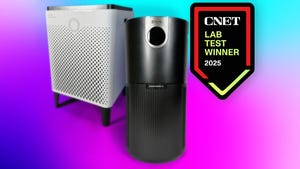
What is the best overall air purifier? Our two new lab winners for high and low fan particle clearing are the Coway Airmega 400S and Shark HP232.
CNETCNET’s pick for best overall air purifier goes to the Blueair Blue Pure 311i Max. During lab testing, Blueair offered the most balanced overall performance in clearing smoke and particles from the air in our controlled testing chamber. It had a T90 (the time it takes for an air purifier to clear 90% of the air) of 1 minute and 28 seconds, making it one of the more effective units in terms of performance. It’s also energy efficient (11.65kWh) and quiet at the quietest at a low fan setting (34.84 dBA), which is what most people will likely run it at. Add this to a reasonable price, and this allows the Blueair 311i Max to retain its title as best overall.
Our lab award winner for the fastest particle removal on a high fan setting is Coway Airmega 400s, which was able to filter a T90 of 21 seconds at the highest fan speed. It also ranked second in overall particle removal and is a great option for large rooms. The Shark HP232 Air Purifier Max earned our other lab award for the fastest particle removal at a low fan setting. It was the top performer in overall particle removal speed, with a T90 of 1 minute and 17 seconds. It was also the cheapest unit to run in terms of energy efficiency.
Best five air purifiers of 2025 Pros
Offers the best balance of particle removal speed, noise and energy efficiency
Lightweight and fairly compact design
Quiet at 43.31 decibels mid fan setting
Energy efficient at 11.65kWh draw
Has all the smart features you’d expect, including automatic mode and voice commands
Cons
Not the best option for larger spaces
Doesn’t necessarily excel at any one particle type
Best for:
The Blueair Pure 311i Max proved to be a jack-of-all-trades in our latest round of lab testing, with consistently high rankings across all our test criteria. It’s the third-highest in overall particle removal across different fan seeds, at 1-minute and 28-second T90 (the time it takes to remove 90% of particles). It’s the second quietest, at an average 43.31 decibels, and it’s energy-efficient, consuming 11.65 kilowatt-hours. Combine this with its medium-sized and it’s the best air purifier for most people who want to tackle particles of different sizes without compromising on noise or energy efficiency. At $230 full price and often less on sale, it’s also a fairly affordable option for the performance.
Why we recommend it:
The Blueair Pure 311i Max has a lot to offer. As mentioned, it’s third in overall particle removal performance with an average T90 of 1 minute and 28 seconds. During lab testing, the Blueair cleared smoke and particles from the air more quickly and effectively than most of its competitors. At the high fan setting, it reduced the particulate count to pre-smoke bomb levels in just 2 minutes.
It’s notably quiet, at 43.31dBA at medium fan settings and the quietest at low fan settings at 34.84 dBA. Even on the highest fan setting, it only reaches 51.95dBA, putting it 9dBA lower than our loudest model. This decibel level makes it quieter than a normal conversation or a household refrigerator.
It’s also fairly energy efficient for its size at 11.65kWh, putting at the middle of the pack, just behind the Shark HP232 at 11.50kWh and better than the power-hungry and larger Coway Airmega 400S (21.84kWh).
The Blue Pure 311i Max also features voice controls and is equipped with a five-color air quality indicator and a particle sensor that detects pollution. Naturally, there’s an automatic mode. Download the BlueAir App, and you’ll be able to track air quality in your home in real-time, control the air purifier remotely, and even track filter usage, so you can order a new one when the time comes. It’s a simple, well-designed air purifier that performs exceptionally well, both in terms of energy usage and particle removal.
Who shouldn’t get it:
The 311i Max isn’t the best option if you need a whole-home air purifier since it doesn’t have the size to filter an entire room. We like the Coway Airmega 400 for that capability. If you need speedy particle removal, we’re also fond of the Shark HP232, which offers fast filtering at a lower fan setting.
Pros
Second in overall particle removal with a 1-minute and 26-second T90 time
Most efficient particle removal at high fan setting at 21 seconds
Can clean up to 3,100 square feet in about an hour and has a high CADR
Features Wi-Fi, app control, auto mode and air quality monitoring and indicator
Cons
Expensive at $750 full price
Noise at high fan at 55.53dBA
Ranks near the bottom in energy efficiency with 24.12kWh draw
Large and bulky
Best for:
The Coway Airmega 400S is the best option for those with large homes who want fast particle removal. At $750 full price, it’s expensive, making it a high-capacity model that ranks second in overall particle removal performance at T90 1 minute and 26 seconds and the most efficient particle removal at a high fan setting at 21 seconds. This earns it our lab award for removal speed.
Why we recommend it:
The Airmega 400S offers top-tier particle removal performance at high fan settings, as mentioned above.
The Coway Airmega 400S is among the largest and most powerful air purifiers on the market, with a hefty price tag to match, but it is an excellent option to consider for larger, open spaces. Its sophisticated four-layer filtration system can handle particulate matter as small as 0.1 microns in size, has among the highest CADR of any available models, ranging between 325 and 400, depending on the particulate matter, and can clear a whopping 3,100 square feet of space in about an hour.
Its functionality and features are on par with the Blueair Blue Pure 311i Max above, including an automatic mode that aids with particles such as smoke and seasonal allergens without running on high continuously. Its footprint, energy draw and price are all a more serious commitment, but it’s still a good value considering its expansive capabilities. For your money, you’re also getting all the bells and whistles: Wi-Fi capability allowing for voice or app control; smart, sleep, and eco settings; and real-time air quality monitoring.
Who shouldn’t get it:
At $750, this is one of the most expensive air purifiers we recommend, so if you still want an air purifier that can quickly clear particles, we recommend the Shark HP232, which still offers fast removal at a lower fan setting. It’s also on the louder side, reaching 45.64dBA at mid fan settings and becoming quite loud at high fan, with a maximum of 55.53dBA. Energy efficiency is also one of the worst we’ve tested at 24.12kWh.
Pros
Fastest particle removal between PM0.5 to PM2.5 at low fan settings
Energy efficient at 11.50kWh draw and the cheapest large air purifier to run
Fairly quiet at medium fan at 44.13dBa
Includes air quality particle indicator and automatic mode
Cons
Particle removal at high fan is T90 1 minute and 9 seconds, making it slower than other similar units
At high fan is on the louder side at 54.51dBA
No app or remote included
Best for:
The HP232 offers great particle removal efficiency with the fastest particle removal speed at 1-minute, 17-second T90. It also did well across particle size ranges, hitting a 1-minute, 15-second T90 time at PM0.5, PM1.0, and PM2.5 particle sizes at the lowest fan setting. If quick particle removal is a priority, the HP232 has the best speed and efficiency at a lower fan setting, making it a good option for quickly cleaning polluted air and earning our lab award.
Why we recommend it:
The HP232 offers good particle removal for particles between PM0.5 and PM2.5, which means it’s great for clearing dust, pollen and smoke. It also has the best particle removal efficiency at a low fan setting, clearing the test chamber in 1 minute and 20 seconds. At high fan speed, there is little improvement, reaching T90 at 1 minute and 15 seconds, which puts it behind other air purifiers.
In terms of energy efficiency, it consumes 11.50kWh, making it more energy-efficient than the smaller Blueair Pure 311iMax. As a result, it is one of the more cost-effective large air purifier units to operate. Noise output isn’t too shabby either, at an average of 44.13dBA, and even lower at its lower fan setting at 37.31dBA, though on high fan, it hits 54.51dBA, putting it on the level of a household fridge.
At full price, it’ll run you $330, so it won’t break the bank either, given its ability to filter air up to 1,200 square feet. You also get a particle sensor and automatic mode, which are increasingly common features on air purifiers.
Who shouldn’t get it:
The Shark comes with optional odor-neutralizing capsules, but these don’t filter air, but rather add a scent to your home, which defeats the purpose of an air purifier if you’re prone to allergies and also adds an additional replacement cost. If you don’t usually operate at a lower fan speed, the both the Coway Airmega 400S (T90 34 seconds) and Oransi Mod Plus (T90 26 seconds) is able to clear the air faster at a high fan speed, with trade-offs in energy efficiency and noise. The Oransi in particular will also do better at coarse particles, while the Windmill 3-in-1 will do better at fine particles smaller than 0.3 micrometers.
Pros
Best fine particle clearing at T90 time of 1 minute, 7 seconds
Very energy efficient at 9.61kWh monthly draw
Quiet at 43.87dBA average
Nice design touches with real bamboo finishes and three color options
Cons
Slow overall particle removal with an average T90 of 2 minutes and 13 seconds
No remote control
Best for:
For quick fine particle clearing and quiet, energy-efficient performance, the Windmill 3-in-1 air purifier is a great option for bedroom, home office and nursery use. It’ll work best on allergens and smoke residue, since it filters fine particles around 0.3 micrometers. The design is also fairly attractive, with a bamboo finish, modern shape and three color options.
Why we recommend it:
The Windmill has a lot going for it. It specializes in filtering fine particles, so it’s a good option for those prone to allergies or in places with exposure to wildfire smoke. The 1-minute, 7-second T90 removal rate is the best for fine particles, though it lags behind in overall particle clearance.
It makes up for this with excellent energy efficiency, boasting a 9.61kWh power draw and generally quiet performance, with an average of 43.87dBA. The price falls into the middle to upper range for the size, at $400 full price, making it more expensive than the Shark HP232 and Blueair 311i Max, but less expensive than the Coway Airmega 400S.
Who shouldn’t get it:
Despite its strong performance in removing fine particles, the Windmill doesn’t impress overall in terms of particle removal. The T90 of 2 minutes and 13 seconds puts it behind the Shark HP232. For more balanced performance across all categories, we also like our best overall, the Blueair 311i Max.
Pros
Average T90 of 1 minute and 29 seconds
Most efficient for coarse particle removal at T90 52 seconds
Second fastest at high fan setting at 44 seconds
Made in the US, has an air quality indicator and 12 fan speed settings
Cons
No app or smart features
Highest energy draw at 66.66kWh for a month of use
Loudest air purifier at 62.80dBA at high fan and loudest across all fan settings
Heavy and large at 23 pounds
Best for:
If you need to filter a lot of coarse particles like sand or pet dander very quickly, the Oransi Mod Plus will do a great job. It’s a large unit that cleans quickly with 52-second coarse particle removal and 44-second removal at a high fan setting. For overall particle removal, it’s not too shabby either at T90 1 minute 29 seconds. However, as CNET senior lab engineer Gianmarco Chumbe pointed out, it comes at the cost of a high energy draw and a loud noise level, as well as a hefty $850 price.
“Oransi has great particle removal efficiency, but it’s the most expensive to run at high,” said Chumbe.
Why we recommend it:
As mentioned, the Oransi+ can clean quickly at high fan settings, especially for coarse particles, making it well designed for a setting that has a lot of sand, pet dander or pollen.
Unusual for air purifiers, it’s made and assembled in the US, and the brand has a reputation for quality construction. It doesn’t come with any smart features or an app, but you do get an air quality indicator so this may be a selling point or a downside depending on what you’re looking for.
Who shouldn’t get it:
The trade-offs with the Orans Mod+ are significant. It’s the loudest air purifier we’ve tested across all the different fan settings. Average loudness is 49.65dBA, putting it above even the other large air purifiers like the Coway Airmega 400S. It also reaches 62.80dBA at the strongest fan setting, making it as loud as a normal conversation or a business office. Additionally, it’s expensive to operate, ranking at the bottom for energy efficiency and consuming 28.32kWh. You can expect a month of energy usage at a high fan setting to consume approximately 66.66kWh. Finally, it’s expensive, costing $850 at full price, making the Coway Airmega 400S $100 cheaper while offering better performance at high fan settings.
Airdog Green Technology Air Purifier X5: The Airdog X5 tests a completely different technology using washable TPA collector plates. Performance-wise, it was slow in overall particle removal, with an average T90 of 3 minutes and 6 seconds, placing it second to last in this metric. It had a moderately high energy consumption (16.06 kWh average), and while its overall loudness was slightly high (48.19 dBA), it was noted as the quietest unit tested on mid fan settings. At $650 full price, it’s more expensive than many of our better-performing options, like the Blueair 311i Max and Shark HP232.
Coway Airmega AP-1512HH(W): The Coway AP-1512HH(W) showed moderate performance in particle removal with an average T90 of 2 minutes and 13 seconds. It was moderately quiet overall (45.19dBA) and was the second quietest unit on low fan settings (34.99dBA). However, this model had high average energy consumption (21.84kWh), especially at its high fan setting (59.6dBA). At $230 full price, it could be a good option if you can find it on sale, but there are better-performing units on our list for particle removal.
The Airmega 400S is a great option for larger rooms.
CNETDyson Purifier Cool Formaldehyde TP09: The Dyson TP09 is a multi-functional unit known for its sleek design, remote control, and multiple fan settings. However, it ranked last in overall particle removal efficiency among all tested models, requiring 4 minutes and 41 seconds on average to clean the air (T90). Although it showed relatively good energy efficiency (10.99kWh average), its poor overall cleaning performance makes it difficult to recommend widely. That said, this is one of Dyson’s older air purifier models, and we’re still testing the latest members of its lineup.
Levoit Core 400S-P Series Smart: This unit offers good overall cleaning performance, achieving an average T90 of 1 minute and 49 seconds. It has moderate energy consumption (13.36kWh) and moderate loudness (46.76dBA overall), ranking as the third quietest in low fan settings. The Levoit Core 400S is a smart model featuring app control and visual air quality indicator rings. At $230, it’s not the most expensive option and comes with useful smart features, so this may be a good option, if you can find it on sale for less than $200, but the Blueair 311i Max offers better overall performance in a similar package.
Morento Indoor AP HY4866-WF: The Morento unit delivered average particle removal results, with an average T90 of 2 minutes and 11 seconds. Its energy consumption was high (18.77kWh average). This model showed inconsistent noise performance: it was ranked the second quietest on low fan settings, but was the third loudest at high fan settings. While the $122 price isn’t bad, the lackluster performance holds it back from a recommendation.
RabbitAir MinusA3 SPA-1000N: The RabbitAir MinusA3 demonstrated decent particle removal performance (2-minute, 1-second T90). It had high energy consumption (18.62kWh) and was slightly noisy overall (47.82dBA). This unit’s key selling point is its customizable design options, including interchangeable art panels, but that alone isn’t enough to give it our recommendation, taking into account the middling performance and $750 price.
Shark HP102: This is one of the few compact air purifiers we tested in this batch, As expected, it offers solid particle filtering, along with high energy efficiency at 7.67kWh (likely due to its size) and quiet performance at 41.48dBA. It’s a good option for bedrooms, a nursery or home office, but the reason it stays off our main list is that with a T90 of 2 minutes and 40 seconds, it has one of the worst particle removal times we’ve tested, even accounting for its size. At $200 full price, we’d expect better performance.
The compact Shark HP102 is quiet and energy efficent, but particle clearing isn’t the best.
CNETOctober 2025: Added new sections on the air purifier we’re currently testing and what’s new in the industry.
November 2025: Tested 12 new air purifiers with our new lab tests that evaluate particle filtering, speed, noise level and energy efficiency to recommend five new products.
December 2025: Removed holiday shopping advice. Updated how we test.
A trend we’re seeing in 2025 is air purifiers getting smaller without compromising on the effectiveness. Dyson’s new HushJet Purifier Compact which we’ll be testing in the lab features an almost jet engine-like nozzle design that lets it purify a room up to 228 square feet.
It’s also interesting that more companies are beginning to incorporate other capabilities into their air purifiers to make them more functional. Dyson is notable for this, with its air purifiers incorporating cool, heating, and humidifying capabilities. We’ve also seen unique models from other companies like Blueair, which incorporates a pet bed into its PetAir Pro air purifier to help reduce shedding and allergies and the EyeVac Air, a unique combo air purifier that incorporates an automatic dustpan into its body. I’m currently testing it next to the litterbox for my three cats.
Blueair’s new air purifier includes a pet bed on top to do double duty.
BlueairTo help inform our air purifier picks, we gathered 12 of the newest and most popular models at the CNET Labs product testing facility in Louisville, Kentucky, where we put them through a rigorous set of tests.
When evaluating our scores for air purifiers, we took into account particle removal ability, energy efficiency, loudness, price and features. Each unit is given a score out of 10 for each criteria, and then receives a weighted final score out of 10.
After we test air purifiers, we also evaluate the top performers for an Editors’ Choice award as the best purchases for most consumers, based on quantitative and qualitative factors like particle removal, energy efficiency, noise level, price and unique features. We also evaluate pure quantitative test results from our rigorous methodology to distinguish a Lab Award winner. In this case, we have two lab award winners for particle removal at different fan speeds.
How we evaluate air purifiers:
Particle Removal (30%): The average amount of time it takes for an air purifier to remove 90% of the particles from our test chamber.Energy Efficiency (20%): The average energy measured in kilowatt hours used by the air purifier, we also calculate it over the course of a month.Overall Loudness (20%): The average noise level across low, medium and high fan settings.Price (20%): We consider how affordable or expensive an air purifier is. Most of our recommendations range between $300 $800, depending on size.Features (10%): We consider features like app control, remotes and design elements that help it fit into a room.The particle-removal testThe air we breathe isn’t just air. In truth, it’s a combination of human-generated and naturally occurring particles. The former is composed mostly of urban, industrial and automotive emissions of hydrocarbons, nitrogen oxides and combustion byproducts, and the latter is mostly represented by smoke from forest fires, sulfates, soot and matter from volcanic activity around the globe.
Gianmarco Chumbe/CNETAccording to the EPA, some of these microscopic solids and liquid droplets, which can be made up of hundreds of different chemicals, are so tiny that it’s almost inevitable to inhale them.
Fine vs. coarse particlesIn terms of smoke, seasonal allergens and dust, an important consideration in buying an air purifier is whether it has an automatic mode. Certain air particles do not remain consistent throughout the year or even throughout the day. “Auto-mode purifiers can automatically ramp up the speed when the pollution is higher,” says Jie Zhao, head of Delos Labs, a human health tech company.
While different kinds of particulate matter are indistinguishable to the air purifier itself, according to the experts we spoke to, an important consideration for particles such as pet dander is energy draw, since that type of pollutant theoretically remains consistent in your home and necessitates constant use of an air purifier.
“It’s more on the consumer experience and user interaction, having it running all of the time, versus the fundamental scientific principle,” says Zhao, when it comes to what makes an air purifier most suitable for pets.
We test our air purifiers against both fine and coarse particle. Coarse particles, PM10 and PM2.5, which are particles of less than 10 and 2.5 micrometers in diameter, respectively, pose the greatest risk to human health since once inhaled. They allocate deep into the lungs and even into the bloodstream, impairing the proper functionality of the lungs and heart. At PM2.5, these include combustion particles, organic compounds and metals.
“That’s the size that can go into our body, into our lungs and go into our bloodstream,” said Zhao. “That is the number one environmental risk factor globally. It kills about 6 million to 7 million people a year,” he said, due to cardiovascular or respiratory problems brought on by particulate pollutants.
At PM10, these include dust, pollen and old. Large coarse particles are greater than PM10 and include fine beach sand (PM90), which i less of a concern since it doesn’t usually enter the lungs, but they can still irritate your eyes, nose and throat.
Fine particles are 2.5 micrometers in diameter and smaller, these include ultrafine and nanoparticles, which have diameters of less than 0.1 micrometers.
Combined average particle removal (low and high fan settings)Shark HP232: 1 minute, 17 seconds.Coway Airmega 400S: 1 minute, 26 seconds.BlueAir 311i: 1 minute, 28 seconds.Oransi Mod Plus: 1 minute, 29 seconds.Levoit Core 400S: 1 minute, 49 seconds.Rabbit Air: 2 minutes, 1 second.Morento: 2 minutes, 11 seconds.Coway Airmega AP-1512HH(W): 2 minutes, 13 seconds.Windmill 3-in-1: 2 minutes, 13 seconds.Shark HP102: 2 minutes, 40 seconds.Airdog AirPurifier X5: 3 minutes, 6 seconds.Dyson Formaldehyde TP09: 4 minutes, 41 seconds.Smoke chamber testOur custom air purifier test chamber uses a clear-view front panel made of plexiglass and gloved hand access, which allows us to manipulate the air purifiers, a particle counter holder for our control device, two fans that ensure proper mixing of the air and smoke inside the chamber, vent ports that ensure there is a small amount of fresh air at all times, an ignition port to light up the smoke bombs from outside the rig, and an exhaust port that removes the remaining smoke safely from the chamber and the building after each test.
The chamber isn’t hermetically sealed, but it’s tight enough to ensure that no hazardous amount of smoke escapes to the surroundings. Our mission was to create an environment in which we exposed each air purifier unit to particle-saturated air of roughly the same concentration to assess how quickly and efficiently they get the air back to breathable conditions.
We made custom smoke bombs, which are made of 50% potassium nitrate (KNO3), 40% sucrose (sugar) and 10% sodium bicarbonate (baking soda) and included a safety fuse for igniting it at a distance. The sugar acts as our fuel source, while the potassium nitrate acts as an oxidizing agent and the baking soda ensures that our dry mixture sustains a slow and even burn.
Gianmarco Chumbe/CNETUsing the GreyWolf PC3500 Particle Counter, we were able to verify that 0.5 grams of our smoke bomb dry mixture produces roughly between 590 million and 610 million particles per meter cubed. The device is able to count particles of different sizes, including PM2.5 and PM10, and it logs this data once every 15 seconds. Although we’re able to count particles of different sizes individually, it’s the total number of particles we care about, which is the sum of all particles of different sizes.
Gianmarco Chumbe/CNETWe prepared a 0.5-gram smoke bomb, which is ignited via the ignition port after installing the air purifier and ensuring proper sealing. Once the air in the chamber becomes particle-saturated (greater than 580 million particles/m3) we turn on the air purifier in question. The data extracted from the Temtop allows us to accurately track the impact that the air purifier has on the particle count in real time.
Noise level Gianmarco Chumbe/CNETUsing a decibel meter, we measured how loud the air purifiers are at their low, medium and high fan settings. This is particularly important if you plan on having your air purifier on in your bedroom overnight and you don’t want it to disrupt your sleep. We performed this test in our sound-enhancing studio to make sure that the decibel meter picked up only soundwave stimuli from the air purifiers, excluding other possible sources.
To give you a frame of reference, a quiet whisper is around 25 decibels. A normal conversation can range from 60 to 70 decibels. A vacuum cleaner is 75 decibels. A subway train at 200 feet away is as high as 95 decibels. With most of our air purifiers no louder than 65 decibels even at maximum fan setting, you’re typically looking at a noise level that’s on par with a normal conversation.
Noise level by average decibel Rank
Air Purifier Model
Average Loudness (dBA)
1 (Quietest)
Shark Small Air Purifier Combo HP102
41.48
2
Blueair Blue Pure 311i Max
43.31
3
Windmill 3-in-1 Air Purifier
43.87
4
Shark Large Air Purifier HP232
44.13
5
Coway Airmega AP-1512HH(W)
45.19
6
Dyson Purifier Cool Formaldehyde – TP09
45.49
7
Coway Airmega 400S
45.64
8
Levoit Core 400S-P Series Smart
46.76
9
Morento Indoor AP; Model HY4866-WF
46.85
10
RabbitAir MinusA3 SPA-1000N
47.82
11
Airdog Green Technology Air Purifier X5
48.19
12 (Loudest)
Oransi Mod+ Air Purifier MD02
49.65
Energy consumptionTo answer this question, we used a device called Kill-a-Watt and measured how much power each air purifier consumed at different fan settings. Knowing the energy draw for your air purifier could make a difference to your energy bill.
Energy efficency rankings measured by average kWh Shark Small Air Purifier Combo HP102: 7.67kWhWindmill 3-in-1 Air Purifier: 9.61kWhDyson Purifier Cool Formaldehyde – TP09: 10.99kWhShark Large Air Purifier HP232: 11.50kWhBlueair Blue Pure 311i Max: 11.65kWhLevoit Core 400S-P Series Smart: 13.36kWhAirdog Green Technology Air Purifier X5: 16.06kWhRabbitAir MinusA3 SPA-1000N: 18.62kWhMorento Indoor AP; Model HY4866-WF: 18.77kWhCoway Airmega AP-1512HH(W): 21.84kWhCoway Airmega 400S: 24.12kWhOransi Mod+ Air Purifier MD02: 28.32kWhBlueair Blue Pure 511: The Blueair Blue Pure 511 air purifier is an effective model in its own right. In our particle-removal test, the Pure 511 cleared our smoke-contaminated test chamber air back to non-hazardous conditions in less than 20 minutes at its lowest fan setting. Every other small-size air purifier we tested took at least 35 minutes to clean the air in that same test. The Pure 511 led the way on the high setting too, clearing the room in a category-leading 7 minutes, 30 seconds. Its low energy draw is the determining factor here, with among the lowest energy requirements of any air purifier, drawing just 0.0135 kilowatts per hour, even on its highest setting. Your best bet for larger spaces, regardless of pollutant type, is still either the Blueair Blue Pure 311i Max or Coway Airmega 400s above, but for a space such as a bedroom where your pets stay with you at night, the Blueair Blue Pure 511 is a decent choice.
Levoit Core Mini: Most air purifiers run within a decibel range of 33 and 55, depending on the model and setting. For comparison, that’s the difference between a light rainfall — easy to sleep through — and a normal conversation volume — less easy to sleep through. Noise might be a determining factor, then, if you’re looking to literally rest and breathe easy by running an air purifier in your bedroom. The quietest of the bunch is the Levoit Core Mini, whose tested volume was only 37.2 decibels, even on its highest setting. (Most other models demonstrated 44 decibels and above.) As a purifier, the Levoit Core Mini isn’t the most powerful, but is suitable for a small bedroom. It can clear 378 square feet in an hour, but only to a particle size of 0.3 microns. This is the industry requirement for HEPA filters, but many other models offer better outcomes. In addition to its extremely quiet running volume, however, it also has the lowest energy draw, at 0.0061 kilowatts per hour, the smallest footprint and the smallest price tag, making it a reasonable investment if you’re looking to try out an air purifier in your bedroom or other small space.
Germ Guardian AC4300: The Germ Guardian AC4300 had medium air-clearing performance among the air purifiers we tested, clearing 612 square feet in about an hour, with a median Clean Air Delivery Rate between 99 and 116, depending on the particulate matter in question. It is suitable primarily for small spaces, with a slightly higher energy draw than those of a similar volume, but a lower running noise level. For those whose primary concern is pathogens such as viruses and bacteria, however, this is an effective model with a relatively small footprint and a modest price tag.
Germ Guardian AC4300
AmazonKenmore Smart 2300E: This is a high-functioning, consistent, fast-acting option with a reasonable price tag for its size and operation, if you’re specifically in the market for a large-room or whole-home air purifier with a moderate price tag. We preferred the Coway Airmega 400s, above, merely for its stated capacity to manage particles down to 0.1 micron in size.
Medify MA-25: The performance didn’t justify the price of this unit. It struggled in our particle removal test and was the loudest of the small-sized air purifiers we tested.
Kenmore 850e (Update: currently unavailable): This unit offers decent particle removal efficiency thanks to its three-stage filtration system and sports a touchscreen display and dimmable night light. It wasn’t quite as strong a performer as the Blueair Blue Pure 511, but is equally budget friendly.
Coway Airmega AP-1512: Above-average performance overall. Sports a color-coded air quality indicator, eco-mode and filter alerts. It has an ionizer option that may enhance bacteria and virus removal, but is a feature that also has the potential for harmful by-products.
CleanForce CP-Rainbow: I was impressed by the performance of this unit. It was the fastest air purifier at removing particles at the high fan setting, removing all smoke particles in just 1 minute and 45 seconds. It comes with app control and voice command, an HD LED display for air quality monitoring and color-coded indicators. It offers just a hair fewer features than other large air purifiers.
EnviroKlenz Mobile UV: The highlight of this unit is that it comes with two UV-C bulbs to eliminate airborne bacteria and viruses. Other than that, it’s quite large and heavy, sitting at 40 pounds. It took the longest to purify the air in our particle removal test, and it’s quite expensive both to buy and operate.
Veva 8000: Not a lot to highlight about this unit other than the low cost and the super quiet design. It was a bottom-of-the-pack performer in our particle removal test and in terms of energy efficiency as well.
The air quality of your home is a significant determinant of your health. Exposure to indoor pollution can lead to health issues, such as respiratory diseases, stroke, lung cancers and COPD. According to the World Health Organization, there were an estimated 3.2 million deaths worldwide in 2020 stemming from household air pollution.
Think of the sources of pollutants indoors as being divided into three categories: contaminants from human activities like smoking or cooking, pollutants from construction materials like asbestos, and biological sources like allergens and mold.
Air purifiers can minimize the health effects of particles of all three categories by removing them from the air. An EPA research review suggests that air cleaners may also improve cardiovascular health. HEPA filters are the gold standard for reducing the concentration of indoor allergens because they can kill 99.97% of airborne particles that are 0.3 microns (µm).
Health benefits of air purifiers:
Air purifiers help reduce symptoms of seasonal allergiesLower your risk of getting sick with respiratory illnesses and other severe conditionsFilter smoke from homesNo device will fully filter out every harmful pollutant in your home. Allergic reactions from large particles or molds on surfaces can still happen. Portable air purifiers are also not intended to filter our nicotine or other gaseous pollutants. That’s why it’s best to use air purifiers as an additional way to clean the air in your home rather than the only one.
While a HEPA filter is an industry standard for air purification systems, an additional measure, a UV-C light, is specially equipped to handle pathogens such as viruses, bacteria and mold, and stop them from multiplying. “The best way to destroy pathogens is just to expose them to sunlight,” says Shahir Masri, associate specialist in air pollution exposure, assessment and epidemiology at UC Irvine Joe C. Wen School of Population & Public Health. “Air purifiers with a little UV light in there will do one extra task for you,” he said.
“If you’re specifically concerned about infectious diseases, that’s what that’s going to be for,” he adds. “It’s a biology killer.”
Read more: It’s Allergy Season: Here’s Where to Put Your Air Purifier
Persistent allergy symptoms, visible smoke or pet hair, and lingering odors can indicate that you may benefit from an air purifier. Air purifiers are helpful even for minor pollutants such as cooking smoke, car exhaust, occasional dust and burning candles.
“Families with young children, older adults, and individuals with chronic inflammation or immune sensitivities can also benefit from cleaner air,” says Hyman.
The cleaner air and increased airflow that air purifiers provide can potentially make a big difference in the quality of life (and breath) for anyone.
People who should invest in an air purifier:
Folks with existing respiratory issues: An air purifier can ease your symptoms if you have seasonal allergies, asthma or respiratory problems.People who have pets: According to the Asthma and Allergy Foundation of America, six out of 10 people are exposed to cat or dog dander. No matter how clean our pet is, the microscopic skin flakes your pet sheds can trigger allergy symptoms, including but not limited to itchy or watery eyes, runny nose, itchy throat, headaches, coughing or respiratory issues. The best air purifiers can help minimize the amount of particles floating around in the air.Those who often deal with smoke: Air purifiers can make a huge difference for those who live in areas often impacted by wildfire. The fine particulate matter from wildfire smoke is significantly more dangerous than air pollution from things like traffic or factor emissions. It’s essential to have one in this situation. Hyman explains that long-term exposure can lead to wide-ranging health consequences like cardiovascular risks, cognitive decline, and metabolic issues, among others.Remember that while the best air purifiers can filter out particles in the air, they’re only so effective in eliminating allergens and pollutants from your home. Once the particles have settled on surfaces, they must be reintroduced to their air for the air filter to clean them. Regular sweeping, vacuuming and dusting will ensure nothing that can hurt your health settles in your home.
Read more: A Step-by-Step Guide to Installing Your Air Purifier
Here’s everything to consider when buying an air purifier. Several of the air purifiers we tested for this best list and the lab awards.
Google Images/ Getty Images/ Zooey Liao/ CNETCoverage and sizeThe primary consideration in buying an air purifier for home use is how much square footage you need to cover. Trying to save money by getting a smaller air purifier than what you actually need will just give you disappointing results. Our picks for the best air purifiers all have high proficiency, so any one of them will effectively clean the air in your home, provided they’re the correct size, placed appropriately and the filters and pre-filters are maintained accordingly. After room capacity, the amount of space the device itself takes up may be important to you as well.
BudgetWhen considering your budget for an air purifier, you might also want to consider not only its purchase cost, but the cost of replacing the filter roughly every six months.
While this list consists only of air purifiers that include a HEPA air filter, which are the most available and highest-functioning models on the market, several of them use more than one type of filtration technology. To better understand those aspects of your air purifier, or if you want to consider buying another type of air purifier, here’s a breakdown of all of the different methods of air purification technology:
HEPA air purifiers: Standing for “high-efficiency particulate air,” air purifiers with HEPA filters — defined by the US Department of Energy as High Efficiency Particulate Air filters — use a fiberglass filter that traps particles of a certain size out of the air. To be HEPA compliant, air filters must remove 99.97% of particles that are 0.3 microns in size and larger.
A HEPA filter can effectively remove smoke particulates from the air.
Colin McDonald/CNETAir purifiers are small, household appliances that use one or more of a variety of technologies to filter particulate matter out of the air, including dust, allergen and viruses and recirculates cleaner air back into your living space. Air purifiers that have HEPA filters are the most popular type available, with many models employing other types of filters in addition to a HEPA filter.
Activated carbon air purifiers: Where HEPA filters manage solid particles in the air, most of the air purifiers on this list also include activated carbon or activated charcoal technology, whose porous nature helps filter gasses or volatile organic compounds out of the air. Gasses in your home air typically present themselves as odors from pets, cigarettes or cooking.
Air quality is a real concern for many Southern California residents with smoke from wildfires and smog having been linked to numerous respiratory diseases.
Gabriel Bouys/AFP/Getty ImagesNegative ion air purifiers: Ionic or negative ion air purifiers work by using high voltage to give an electrical charge to particles or molecules in the air, which causes them to clump together and seek out positively charged molecules with which to bond. Certain models that use this type of technology also include a positively charged collector plate that the ionized particles will stick to, taking them out of the air. (Without a collector plate, these particles are no longer circulating in the air, but may hang on surfaces to be cleaned or vacuumed out of your home.) Most models employing this technology don’t use fans, which requires more time to filter the air in a room but also makes for extremely quiet conditions. Many experts caution against this type of air purifier, however.
“Those kinds of filters essentially are not necessarily removing contaminants from the environment, but converting them to dust and surface contamination,” says Masri. “And one of the issues with those is you can generate a byproduct, which is ozone. So you exchange one pollutant for another.”
UVGI air purifiers: “Ultraviolet germicidal irradiation” air purifiers are similar in mechanical function to HEPA air purifiers, in that they use fans to recirculate the air to purify it quickly. Inside the device, UVGI air purifiers rely on shielded ultraviolet light to neutralize dust and allergens. This type of technology isn’t available in air purifiers for home use and is typically employed in larger systems available for public settings such as office buildings.
CADR stands for Clean Air Delivery Rate, which is a measure of an air purifier’s ability to clean the air, measured in cubic feet per minute. According to the Association of Home Appliance Manufacturers, “the CADR of your air cleaner should be equal to at least two-thirds of the room’s area.” So, for example, a 10-foot by 12-foot room with an area of 120 cubic feet would require an air purifier with a CADR of 80.
HEPA air purifiers, which represent the vast majority of those on the market, are the most capable of decreasing health risks associated with air pollutants because of their ability to filter particular matter down to a microscopic size that our mouths and noses can’t naturally filter. “That’s the gold standard that’s used anywhere in hospitals, in surgery operation rooms and in airplanes,” according to Zhao. All HEPA filters can manage particles down to PM 0.3, with several models offering protection down to PM 0.1.
An air scrubber is “a very, very powerful, industry-level air purifier,” said Zhao, which is the kind of large device that is used in “factories, hospitals, warehouses, or military settings.” Air scrubbers use technologies similar to those of home air purifiers, but on an industrial scale and are often built into ventilation systems. UV-C light is often used for germicidal purposes in an air scrubber.
Air purifiers don’t affect the level of oxygen in the room in any way. Your air purifier is recirculating the air already in the room and cleaning it by passing it through a filter where microscopic, solid particles are removed. It is neither removing or adding additional oxygen into the space. Air purifiers are also not the same as freestanding air conditioners, although the increased airflow from an air purifier may make the air in your home appreciably cooler.
How often you change your air purifier filter will depend on a few things, including how much you use your machine. It’s recommended that you change your air purifier filter at least every six to 12 months.
However, you may end up needing to change your filter more if you notice signs of clogging, an excessive amount of dirt buildup, reduced airflow or poor performance. Some air purifiers have a light indicator that’ll let you know when you need a new filter. Others may send a notification directly to your phone via its companion app.
Depending on its design, an air purifier should be placed as centrally in a room as possible, to make sure that all access points of the purifier are open to receiving air. Some circular models have 360-degree functionality, while others may only be collecting air from particular faces of the device. In either case, an air purifier shouldn’t be placed directly against a wall and should allow for at least several inches of clearance. Placing it near doorways and vents that are also creating airflow may help with your air purifier’s efficiency.
Studies have shown that air purifiers can significantly improve allergy and asthma symptoms. That said, they can only be so effective. Keeping your environment clean is also essential because once the allergens settle on surfaces, your air purifier cannot filter them out. They need to be reintroduced to the air through activities like sweeping, dusting or vacuuming for the air purifier to help.
For maximum air purifier efficiency, it’s important to isolate the air purifier within a defined space, which can be more difficult to do in open floor plans. For the best efficiency both in terms of clean air and energy uses, also keep windows closed when using an air purifier.





GIPHY App Key not set. Please check settings