 Mr Viral
Ever since I purchased some cat food on Xiaohongshu, China’s trendiest social media app, the algorithm has been bombarding me with all kinds of pet-related content — countless cute photos, cat toy ads, even pet livestreams.
As a scholar of religion, the posts that piqued my attention were religious tips for how to handle your pet’s afterlife. For instance, I came across a set of detailed guidelines on how to conduct the pet version of zuoqi — the traditional 49-day period of mourning and rituals that follows the death of a family member.
These guidelines included information on setting up memorial tablets, burning incense, lighting candles, placing offerings, reciting the rebirth mantra, and praying for one’s pet in the afterlife. On Xiaohongshu, better known as RedNote in the West, you can even buy joss paper offerings designed especially for pets. Packages range from basic to deluxe.
Zuoqi integrates Confucian filial piety, Taoist rituals, and Chinese folk customs, but is mostly based on the Buddhist concept of zhongyin, or the “intermediate state between death and reincarnation.” After a person dies, they are judged every seven days for 49 days by the Ten Kings of Hell. During this period, living family members can conduct religious rites and rituals to accumulate merit for the deceased so that they will suffer less punishment in the underworld and achieve a favorable rebirth.
The pet version is no less serious. For instance, on the seventh day after death, when the spirit of the deceased is said to return home to pay a visit, pet owners will prepare food, water, and their pet’s favorite toys. And just as paper offerings are made for humans to provide them with necessities in the afterlife, so too for pets: paper kennels, paper food bowls, and even paper money.
Intrigued by the many Xiaohongshu posts, I dove deeper into how Chinese people are turning to religion to deal with the deaths of their beloved pets. I discovered that this trend has forced temples around the country to confront the question of how — or even if — their religions can accommodate deceased animals in their rituals.
The fact that a pet’s death is increasingly being treated as that of a family member shows the rising importance of animals in people’s lives. In the past, animals were valued for their ability to assist humans, such as catching mice and guarding the home. Now, however, they are doted on by owners who affectionately refer to them as “fur babies.”
A report last year by iResearch Consulting Group about China’s pet industry explains that China’s gradually aging society, declining birth rates, and falling marriage rates stand in contrast with people desiring more companionship and other ways to meet their emotional needs.
As a consequence, the passing of a pet is now more likely to leave owners distraught and looking for ways to alleviate their sadness. Some pet owners, after carrying out zuoqi rituals on the seventh day after death, even report traces of their pet having returned, such as the cat food they left out having been eaten.
Bereaved pet owners looking for further consolation can turn to the specialized “pet communicators” who also offer their services on Xiaohongshu. They claim to help owners communicate with their pets and identify their whereabouts after their reincarnations — just like spirit mediums who say they can connect people with their deceased loved ones.
Following cremation, some owners want to keep their pet’s ashes at home or use them to create keepsakes. Others, following traditional beliefs, prefer a burial. The problem, however, is that China lacks a legal framework for approving pet cemeteries.
As such, some providers of pet funeral services have joined hands with Buddhist temples, which have set aside “resting places” within the temple grounds or place ashes in their merit halls — the place where memorial tablets of deceased ancestors are placed so they can listen to sutras and scriptures and accumulate merit.
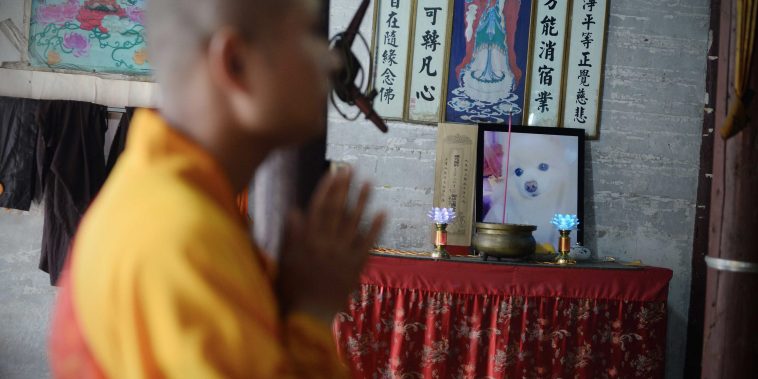
Some Buddhist temples have even set up halls for storing the ashes of pets and begun organizing special salvation rituals for guiding pets to the afterlife. In the run-up to this year’s Qingming Festival — the time in spring, also known as Tomb-sweeping Day, dedicated to one’s late ancestors — I witnessed such an event at a temple in Shanghai.
A dozen or so benefactors participated, each paying a merit donation of 100 yuan ($14). An abbot told me that this was the first time the temple had held collective salvation rituals for deceased pets — most of which were laid to rest in a shaded spot beneath some trees on the temple grounds. Similar to what they would do for a human, monks then recited mantras and sutras to help absolve the pets of their negative karma.
As for why such a ceremony was held, the abbot explained that temples are service institutions that exist to help people, and they will endeavor to accommodate believers’ demands, as long as they are reasonable and legal. In addition, all sentient beings are regarded as equal in Buddhism. After the karmic retribution of the animal realm is cleared, it is possible to be reborn as a human, although the ideal is to transcend the cycle of rebirth.
In the temple’s merit hall, I spotted a spirit tablet dedicated to a deceased cat, which had a photo of the animal attached to it. The abbot told me that this benefactor originally visited the temple to attend a pet memorial service, discovered that there was a merit hall here, and decided it was a good place to remember the deceased. Not only did she get a spirit tablet for her cat, but she also got one for her father.
I was also curious about how Taoists deal with this trend, given that they approach the afterlife differently from Buddhists. In Taoism, after a person dies, their relatives will hold a salvation ceremony to refresh the deceased’s body with pure qi, or vital energy. Karma also plays a role.
Before this year’s Qingming Festival, Taoist temples across Shanghai were busy preparing for the universal salvation ceremony. I spoke with the abbots of three Shanghai temples to find out if any people had signed up their pets for the rituals. All three confirmed that they had.
There are however questions among the Taoist abbots I spoke with about whether pets should or even could be part of salvation rituals. One central issue is whether salvation rituals can be performed for pets alongside people’s ancestors — or humans in general.
On that last point, views among the Taoist community in Shanghai are relatively consistent, believing that doing so would indeed be inappropriate. For that reason, one of the temples had removed the pet registrations and refunded the donations. The other two did add the names to their lists, given the number of pets was relatively small. To avoid this issue, some Taoist temples across China have opted to hold ceremonies specifically for pets.
There is also the question of whether the rituals as they exist right now are suitable for animals. Abbot Hou, of one of the three temples, explained that various issues remain unresolved. There is the question of how memorial tablets for pets should be written; the blood relationship between benefactor and deceased plays a key role, but does not exist between owner and pet.
The most crucial problem, however, is that there are no standardized ritual books on the matter. Buddhist rituals are relatively straightforward — simply involving reciting sutras and mantras. Taoist rituals are more complex and contain various chants that need to be modified.
Hou’s temple previously considered holding a collective ceremony for pets, but the monks all felt that reciting from existing ritual books would not be appropriate. With neither the staff nor the time needed to create a suitable standardized text, the temple decided to shelve the project.
There is even disagreement in the Taoist community about whether pets — or any animals for that matter — can be the recipients of salvation rituals at all. Abbot Kong, of another Shanghai temple, believes that all living beings have the right to be nourished by the Tao. He listed evidence from Taoist scriptures dating back centuries that indicated that all things have the right to take refuge in the Great Way and be saved.
Abbot Yuan, from eastern China’s Zhejiang province, argued that animals not only could, but should receive salvation rituals. Based on the texts that introduced the concept of universal salvation into Taoism, the Lingbao Scriptures from the Six Dynasties period (220–589), he believes that being reborn as an animal is essentially a form of karmic punishment. Therefore, the importance of the salvation rituals is that they allow the soul to escape the animal realm as soon as possible by achieving human form or even ascending to the celestial realm.
“Owners and their pets share deep bonds and connections. In fact, owners have a responsibility and obligation to perform salvation rituals for their pets, because that helps them from a deeper level of karma and karmic burden,” Abbot Yuan said. “As Taoist priests, we should follow the compassion of the Heavenly Lord and bestow the method of universal salvation upon pets to help them achieve the path of life and escape the path of death.”
However, Abbot Li from Guangzhou, capital of the southern Guangdong province, disagreed. He believes that religion only concerns the souls of humans, with other living beings being secondary, although a place can still be reserved for non-humans in rituals. Animals can be recipients of Taoist food-offering ceremonies. However, rituals that allow ascendancy to the celestial realm are for humans only.
The clashing views within and between Buddhism and Taoism about the afterlife of pets mirror how pet owners themselves deal with the passing of their furry friends. They chant sutras in the hope their late pet can reincarnate. But when they burn paper offerings for their pets, they seem to acknowledge they haven’t, and have instead gone to another realm. At the heart of these seemingly contradictory behaviors is the need for bereaved pet owners to comfort themselves, which, of course, is remarkably similar to how we deal with the passing of a human loved one.
Translator: David Ball.
(Header image: A monk conducts a funeral rite for a pet dog in Shanghai, 2015. VCG)






GIPHY App Key not set. Please check settings