 Mr Viral
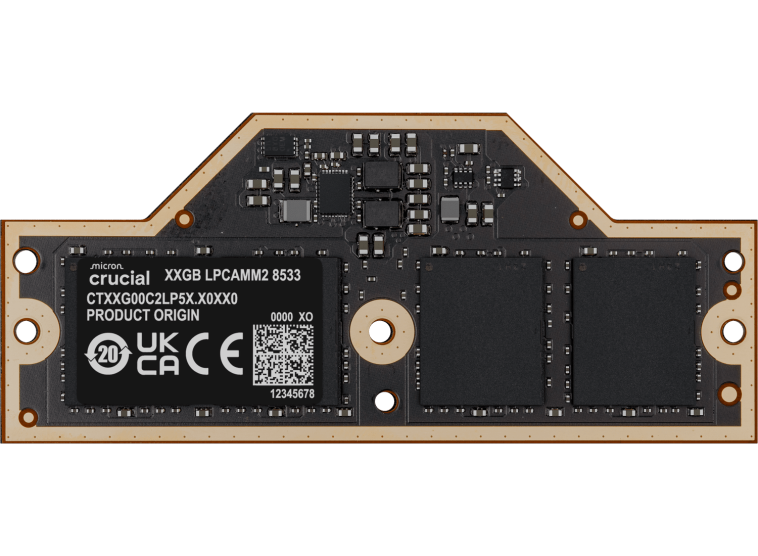
Half the size of a regular SODIMM. (Image Source: Crucial)The latest LPCAMM2 modules with DDR5-8533 speeds are perfect for AI-enabled laptops that need versatility, performance and power efficiency. Size is just half of the regular SODIMMs, performance is increased by 1.5X and the modules can be easily replaced, unlike traditional LPDDR5X RAM.
Crucial is among the first RAM module producers to adopt the LPCAMM2 standard for laptops, which enables faster transfers, more efficient power management and increased capacities per module. The company recently announced availability for its new LPCAMM2 RAM modules with DDR5-8533 speeds, signaling a greater demand for the new RAM standard.
The new LPCAMM2 modules from Crucial use LPDDR5X chips and controllers from Micron, but the modules are not soldered as with traditional LPDDR SODIMMs, so they can be replaced and upgraded, which is particularly useful for laptop owners.
Another advantage is the smaller form-factor, which has been reduced to less than half the size of a SODIMM. Despite that, capacities are now doubled, reaching 64 GB per module.
Performance is estimated to be 1.5X higher, and thanks to the inclusion of on-module SPD and PMIC controllers, power consumption is also noticeably lowered.
These new modules are recommended for AI workloads, but they also excel at general multitasking scenarios involving content creation, gaming and rendering.
For the time being, LPCAMM2 support is only offered for Intel processors on select laptop models like the Lenovo ThinkPad P1 Gen7 mobile workstation and the Dell Pro Max 14 / 16 or Pro Max 16 / 18 Plus mobile workstations. AMD and Qualcomm ARM-based support is expected to arrive in 2026 as more laptop OEMs adopt the LPCAMM2 standard.
Crucial’s official site is listing the DDR5-8533 LPCAMM2 module at $232.99, while the 64 GB variant has a $451.99 MSRP. Prices should also drop as adoption increases.
Related Articles
Bogdan Solca – Senior Tech Writer – 2373 articles published on Notebookcheck since 2017
I first stepped into the wondrous IT&C world when I was around seven years old. I was instantly fascinated by computerized graphics, whether they were from games or 3D applications like 3D Max. I’m also an avid reader of science fiction, an astrophysics aficionado, and a crypto geek. I started writing PC-related articles for Softpedia and a few blogs back in 2006. I joined the Notebookcheck team in the summer of 2017 and am currently a senior tech writer mostly covering processor, GPU, and laptop news.
Bogdan Solca, 2025-10- 1 (Update: 2025-10- 1)






GIPHY App Key not set. Please check settings