 Mr Viral
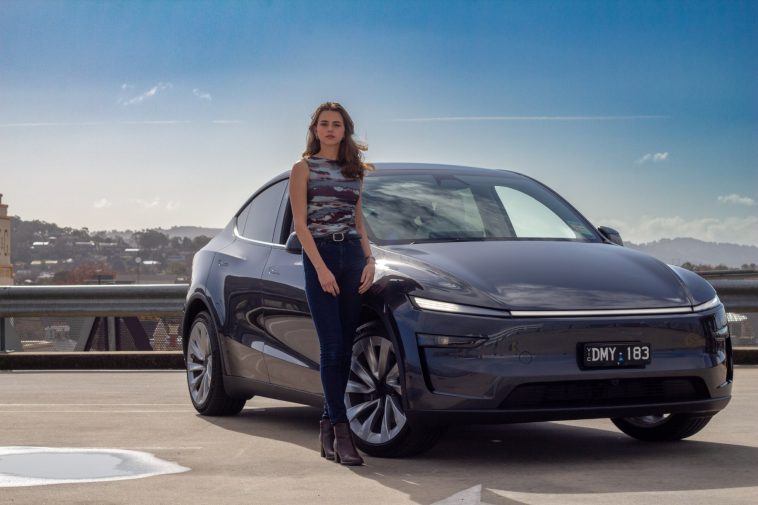
The Tesla Model Y has firmly established itself as a leader in the Australian electric SUV market, but there’s new, refreshed version from the original 2022 option.
I’ve just stepped out from behind the wheel after a week and it’s clear the car will meet the needs of and appeal to, many Australian families.
The series of changes Tesla has made, elevates the entry-level Model Y from a practical EV to a premium, feature-packed machine. Importantly the refresh incorporates lots of ideas the community asked Tesla to change, and even some ideas they didn’t.
While the base model is a compelling package on its own, this review delves into whether these popular additions are worth the extra investment and how they shape the overall ownership experience. It’s a configuration that promises the best of all worlds – style, technology, and value.
Design
Tesla’s Model Y is now a staple on Australian roads, a familiar sight, yet it continues to turn heads with its minimalist and aerodynamic silhouette. The refresh is a significant change to the styling and while the change was jarring at first, it’s really grown on me and I now really prefer it over the original.
Exterior
Our review vehicle was painted in Stealth Grey, The paint has a wonderful depth, shifting from a flat grey in overcast light to a liquid-like metallic under the bright Australian sun.
There’s a total of 6 colours on offer, the pick of the bunch for those who want to stand out is the Ultra Red (A$2,600), or perhaps the new colour, Diamond Black released this week for a A$1,500 upgrade, but honestly, even the included Pearl White Multi-Coat looks pretty great.
This review unit features upgraded 20″ Helix 2.0 wheels, a $2,400 option from the standard 19″ Crossflow Wheels. Personally, I think these look best as silver against the white paint and that Tesla would offer a dark version of the Helix 2.0 wheels.
Front and the back
Two of the most obvious, in your face changes to the Model Y is at each end of the car. The front now drops the Tesla logo from the hood, and opts for a clean design with the new front bar much more elegant than the elongated duck bill from the original.
Designers were able to make it look visually much more appealing, while still delivering a strict aerodynamic efficiency that shows itself through great range figures.
The full-width light bar not only looks great, but performs really well. Driving at night really helps with the amazement.. how could so much illumination come from such a thin profile, technically, this is brilliant. I was never flashed by an oncoming vehicle for my lights being too bright, thanks to the new matrix LEDs turning off sections of the light as vehicle approach, while maintaining the maximum brightness possible for you as the driver.
On the rear, that’s where the most unique lightscape is seen. This whole single lightbar is distinctive, it reflects the light down to the ground which follows the car like you have the afterburner glow from a rocket chasing you. It’s different, it’s cool, but I’m not sure it’s something others will copy.
Practically, the red glow does illuminate your surroundings when you’re stopped, providing great lighting while your car is stopped. It doesn’t really help when your loading bags at night as the lightbar is on the boot and when the boot is opened it doesn’t shine to the ground.
Personally I’d like Tesla to be consistent with design choices across the range. As good as the Model Y is now, it does raise an issue with the Model 3 that was only just refreshed itself last year, but lacks any of this lightbar magic. Tesla will soon have lightbars on the Model Y, Cybertruck, Robotaxi, but not the Model 3, S or X.
Interior
Stepping inside, there’s a refined, minimalist interior Tesla are known for and this aligns well with my taste in vehicles. Everything that can be digital, is, with one exception, that controversial indicator stalk.
Seats
Tesla has always had incredibly comfortable seats and the new Model Ys are no exception. Despite very positive feedback, they aren’t resting, constantly improving their seating choices. These now offer perforations to allow the heating and cooling to flow through freely.
While this review took place during Australia’s winter, the cooling aspect is a welcome addition and would could be motivation alone for some upgraders to make it through a hot Australian summer. While cabin pre-cooling certainly works, cooling your body from direct airflow, instead of indirect, is far more efficient.
AC swing
Another nice new feature is to have the airflow swing left to right like an old fan. This helps keep you cool, but distributes the cooling, rather than a concentrated hotspot (or coldspot). I didn’t think I’d like this feature as much as I do.
When you consider how Tesla achieves this, their digitally-controlled vent system already uses small servo motors to move levers behind the dash to direct the airflow. This feature really automates the continues movement of the vent directions on the X axis. It’s another showcase of Tesla’s software-defined vehicle that isn’t available to a lot of other automakers that still use traditional manual vents.
Rear Display
The can is amazing from the front row, but from the rear, the inclusion of a display makes it a nicer place to spend time. Not only do you have an amazing vista of the night sky, or the towering buildings of a cityscape, you also get to control your entertainment options.
When you have rear passengers, you’ll get a request to allow them to play DJ and takeover the vehicle’s audio. The other alternative is to connect a Bluetooth headset which is an excellent option.
Space and Storage
A massive part of the motivation to buy an SUV and spend a few thousand dollars more than the Model 3 sedan, is the amount of additional storage space you get. The frunk is larger, the trunk is larger to the point where you can literally fit some suitcases and bags in the Y, that you simply can’t with the 3.
When it comes to other competitors, the Model Y is a leader in storage capacity in the mid-size USV segment. Tesla’s efficient packaging of it’s electric drivetrain means they are able to deliver the benefits (more storage) to customers. If you’re travelling with 4 adults, or 2 adults and 2 kids, you’ll appreciate every inch of this additional space.
Electronic fold down seats
This one is a real convenience feature. If you open the rear tailgate, have something large you need to slide in, but your seats are in the way. Tesla has had fold down buttons for a while in the back of the Y, but these were dumb, in that they’d just release and hope there was nothing in the way.
The fully electronic approach will even move the front seats forward to make room for the rear seats folding down. Then once you remove the object, you’ll want to return your car’s configuration to normal. This typically meant more doors opening and closing and general messing around that can and thankfully is, now avoided. Just push the buttons again in the boot and the seats return to normal, ready for passengers.
There was a bit of design and a bit of programming involved by the software team to achieve this, but it’s a convenience feature that can make a difference to people who regularly shit from moving people to moving things and back again.
Interior lighting
Following the design update from the Model 3 last year, Tesla has integrated an RGB light bar to the Model Y. This extends across your view under the windscreen, through the driver and passenger front doors, and even to the rear passengers doors.
This adds a nice layer of personalisation found in some other vehicles, although I would have liked to see the RGB find it’s way into the footwell lights as well. I was glad that the RGB lighting never created an issue with reflections on the windscreen, even at night when reflections are high, clearly Tesla designers tested for this and found by insetting the lightstrip, the glow doesn’t reach the windscreen and create a driver distraction.
Performance
The driving experience of the Model Y RWD is defined by its instant, silent acceleration and nimble handling. Your perspective of just how fast this car is will really depend on your frame of reference. The RWD Model Y will accelerate from 0-100km/hr in 5.9 seconds. Compared to most ICE vehicles, that’s incredible, but if you also want faster, the dual-motor Long Range does the same acceleration in just 4.8s, more than a full second quicker, something you’ll definitely feel behind the wheel.
While there’s a Performance spec on the way, it’s currently not available. The last generation did the 0-100km/hr time in 3.7s which is wild for a mid-sized SUV that weighs as much as it does.
Having driven the new Model Y RWD for the past week, it’s day-to-day driving performance is more than adequate, it’s fun. You get off the line smartly which helps to get you ahead of the traffic with plenty of time to switch lanes before the next turn. You can also pull out for an overtake with confidence that you’ll get it done with time to spare.
Suspension
One of the big headline changes with the new Model Y is it’s updated suspension. My basis for comparison is the 2022 Model Y RWD and having ridden quite a lot in that, the suspension is certainly improved.
The way it rides bumps is just smoother, not eliminated, you’ll still feel them, but it avoids sending the jarring forces through your body which is certainly appreciated. Would I sell my old Model Y and upgrade for that alone, no it’s an improvement, but it’s not air suspension. A bigger improvement would be if the Government and councils improved road maintenance, I may be biased, but they seem particularly bad in Victoria. Ironically, the Tesla requires very little maintenance of it’s own, mostly just tyres.
Often a consequence of improving ride comfort with suspension changes is that you see (or feel) an impact to vehicle handling, stability and cornering. It’s possible you can turn your car into a floating bus on wheels, but turn a corner and it’ll want to roll like a boat. Thankfully Tesla engineers worked their magic and managed to deliver a car that has a better ride, while not destroying it’s sporty, fun, cornering abilities on great windy roads in the country, this is a real credit to the team.
Noise
The upgrades also include changes to the glass, now acoustic all round, the car is quiet, like eerily quiet. When I first started driving EVs, I noticed how much of an improvement they were to in-cabin conversations. Without the noise from the engine and exhaust, you can easily hear people speaking between the front and rear rows. This has been further enhanced by the changes made in the new Model Y.
I’m someone who often listens to music, probably way too loud and while I certainly appreciate the great sound system in the Model Y, I intentionally left it off on a number of drives this week. I found myself thinking.. this is easily the quietest driving experience I’ve ever had. Road noise changes a little between road surfaces, but honestly, it’s such a big improvement, I wish all cars would do this.
Range
The hard work done in the design and engineering departments at Tesla result in some of the best range on the market, particularly when you break it down to Kilometres from Kilowatts. The Tesla Model Y Rear-Wheel Drive is rated for a range of 466km (WLTP) and if that’s not enough, the Long Range All-Wheel Drive is up to 600km (WLTP) now, after a mid-week update to the range figure.
Tesla has just launched in India and offered a new variant not available here, the Model Y Long Range RWD which actually has 622km of range, achieved by the reduced weight with no front motor.
Practically you won’t get those numbers, the real world numbers are probably 30-40kms off that, but this is the case with all EVs and the commonly used efficiency figures used for Australian EVs. While the car is incredibly easy to drive, I think the 430ish kms of real world range on the MY is plenty for 90% of customers which is why we see it represented as the most popular variant.
While they look the same, the RWD model uses an LFP chemistry in the battery. This offers a number of great attributes like longer lifespan, lower cost and can regularly be charged to 100%. The only downside is you don’t get the wicked deployment of power you can in NMC-based batteries. Given the vast majority of owners don’t prioritise sports-car performance, the RWD is the perfect fit for most.
For those who embark on outlandish road trips to far remote locations and just have to have more range, the Long Range is there as an option, but does come at a A$10k upgrade for a 134km range boost.
In time gone by, Tesla’s wheel choice impacted range, yet currently the checkout shows the exact same range for 19″ or 20″ wheels, such is the aero efficiency of the modern designs.
When it does come time for charging, you’ll have access to the most charging locations in the country. Tesla is rolling out plenty of new Supercharger locations to Tesla and Non-Tesla vehicles, but the work done over the past 10 years means Tesla’s locations and reliability is unrivalled.
It’s important to understand that Tesla doesn’t include charging cables with the car, so be conscious to lookout for these at checkout. You can go down the path of a faster home charger installation (est. $1,500 installed), but personally, the $550 mobile charger that plugs into any outlet has worked great for me over the past 5 years.
Features
The list of changes may be long, but there was one feature I was keen to try the most, Smart Shift.
This is ultimately a convenience feature, with Tesla continuing to takeover driving features and this is another that is possible thanks to their use of computer vision AI.
With no drive selection drive stalk in the new Model Y, you’re default option is to switch from Drive, to Reverse and to Park, using the right side of the touchscreen. While this takes some adjustment, after a couple of days, it’s pretty easy to transition the muscle memory to look there, rather than reaching for the right stalk.
With Smart Shift enabled, Tesla attempts to guess the direction you want to travel. I say guess, but there’s not really guess work involved, its actually a logical choice based on the available data.
If you pull forward into your garage at the end of the day, when you go to leave in the morning, you will always need to reverse to leave in the morning. Tesla uses the cameras that surround the car to determine available space around the vehicle and with the garage door open, reverse is the logical choice.
One of the best ownership experiences is entering and exiting the vehicle, because of how fast and easy it is to do. Walk up to the car in the morning, it unlocks thanks to the Bluetooth-enabled phone key in your pocket. You open the door, get in, seatbelt on and press the brake. You tap it once more and the car switches to reverse, activating the rear view camera on the center display. Simply depress the accelerator and you’re off and racing.
When you get to the end of the driveway, here’s where things get interesting.. You reach the end of your driveway and turn the wheel, you press the brake to bring you to a stop and turn the wheel in the direction you wish to travel. These two key attributes tick off the required list to shift to forward and you simply accelerate away.
Once you get the hang of this (2-3 times), it really feels magical, like the car is readying your mind and helping you perform manual functions, automatically. In reality, it’s a really smart implementation of technology, leveraging data you’ve provided the vehicle about your intent, without even thinking about it.
Some would argue this is Tesla solving a problem they created by removing the drive stalk, Regardless of the motivation, the Smart Shift feature works great in my experience, even accurately identifying a chicken-wire fence.
Having used it dozens of times during the week, I can’t remember a time where the system missed.
Autopilot
Included by default, this option is amazing, I won’t buy another car without it, it’s that bloody good. This tracks the lane lines, even around tight bends and keeps you inside them. It adjusts your speed to the cars ahead and adjusts automatically.
This helped me for 90% of my drives and honestly, I wish it was 100%. It can’t do roundabouts, it can’t turn city street corners and it needs at least 1 painted line on the road to activate. When it does, it feels like you have a digital assistant that helps you drive.
We humans are not great at maintaining concentration on mundane tasks for extended periods of time, so the technology is here to help and help it does. Having driven hours down the Hume Hwy, I exited the vehicle feeling fresh and ready to take on the day, compared to the mental fatigue that often comes from constantly monitoring and hoping other are in control of their vehicles.
Enhanced Autopilot (EAP)
This is an optional upgrade to the standard Autopilot system and costs A$5,100 which is not a small sum of money. For the coin, you get new features in the car including Navigate on Autopilot that will automatically change lanes as your car approaches slower moving vehicles on divided highways.
You car can also does smart lane changes which checks the available space around the vehicle before performing a change, meaning you can virtually forget about head-checks.
Next we have the Autopark feature for either parallel and perpendicular parking. This was originally a party trick, but in recent upgrades allows you to select a parking bay and the car turns, drives forward and back to manoeuvre into the park with great success.
It’s important to highlight this is not perfect and ~2/15 times I had to intervene, usually because it was slower than I’d like, but there was a time were I genuinely think I saved it from backing into a barrier, having selected a shorter than normal parking bay (note: feature still in beta so just monitor and take over where you need to).
Finally there’s Summon, which allows you to move the car in and out of tight spaces using the Tesla app. This can help you avoid stepping in a puddle, or help you park in a parking garage and still have room to enter and exist the vehicle, as long as you have mobile reception which sometimes you won’t in an underground carpark.
Full Self Driving
Something I actually really missed in this review vehicle was Traffic Light and Stop Sign control. I have this in my Model 3 and while it’s annoying to have to confirm on green, my mind is at ease knowing the car has my back, again. My car is not going just going to blow through the lights if I was momentarily distracted.
I found curvature assist slowed at some intersections when you had a route set, but not reliably down to zero. The big feature of course is the one we’re all waiting for, FSD (Supervised) which has been teased in a video from Tesla AI, showing the car turning corners autonomously in Melbourne earlier this year. We want it yesterday and hopefully when it ships, it comes with the subscription purchase option as $10,100 outright isn’t it.
Dashcam
Tesla’s decision to leverage cameras around the vehicle also presents an opportunity to use those cameras as a security system. While this has been available for many years, there’s a new camera in the mix now and the Dashcam app in the new Model Y is updated compared to mine.
With a recent software update to Tesla’s with the AMD Ryzen-based processor, they can now see security events in a quad-view. Such is the processing power available, it can play 4 videos at once, which apparently is not the case for the older Intel-based processors.
This is really hand when reviewing footage, as you often select a camera and hope the event occurs the most on that camera. The quad view, combined with the ‘Jump to event’ button will skip along the timeline and you’ll see immediately which side of the car this occurred on. This is a great inclusion.
15-inch Central Touchscreen
The command centre of the vehicle, controlling everything from navigation and media to climate and vehicle settings with a fast and intuitive interface. I love showing new people this aspect of the car, as it’s the most different to what they’ve experienced in the past. Tesla’s digital-first approach brings a great level of consistency in the design and this is backed up by the ability to control most things using your voice.
One noteworthy change is that the display now features reduced bezels, making it look new and modern like our smartphones, and while this won’t sell a vehicle on it’s own, I’m glad Tesla updated this.
Issues and Opportunities
While this configuration is highly desirable, it’s not without its considerations.
Rear Parcel Shelf
Tesla has included a removable rear parcel shelf for the new Model Y. This is designed to hide your goods from view, although I’m not sure why. The view into the rear is extremely limited, thanks to the tint on the rear window. We know Tesla takes the approach to ‘the best part is no part’ which makes this decision a little strange as it does add costs to the car.
The designers did thoughtfully consider how you’d store this when not in use, and made provisions for it in the lower boot section. I found that while it fit (folded), the cover doesn’t sit flat, acting like a spring below. If you loaded suitcases or gear in the back this would be heavy enough to weigh it down, but running it normally, there are times where you can hear it moving and it’s just not the slick experience I expect from Tesla.
The parcel shelf itself is difficult to remove and install. Compared to others that have simple clip-in anchor points, this simply lays on top of the carpeted rails. When you need to load almost anything, it’s in the way and will need to either be folded back or completely removed. I found doing this almost never happens in one simple action, instead it’s a lot of faffing about. While I appreciate Tesla responding to customer requests for something in this space, I think the should have pushed back on this one.
Speed Sync
One of the downsides I noticed in driving a Tesla without a drive selection stalk, is that there’s a function that doesn’t have an alternative. When you drive past a speed sign, the car typically will sync it’s set speed with the newly identified speed zone, but not always.
When there are these exceptions, you’ll need to override the detected speed some and in my 2019 Model 3, I simply pull down on the right stalk and it’s a command to the car to manually sync the speed again. Unfortunately without this stalk, there’s no other alternative available, at least not currently.
Could Tesla allow the left scroll wheel to be customised to include this as an option? Of course they could and this would remove the final requirement for the drive selection stalk. I suspect they are so close to shipping the next build of software, based on FSD (supervised) in the US, that allocating engineering effort to doing this won’t make sense.
Price and Availability
The New Tesla Model Y is available now directly from the Tesla website. The pricing is as follows:
Base model
Tesla Model Y Rear-Wheel Drive: $58,900 | $64,373 Driveaway (VIC)
Review spec
Tesla Model Y Rear-Wheel Drive: $66,500 | $70,417 Driveaway (VIC)
Stealth grey paint: $1,900
20″ Helix 2.0 Wheels: $2,400
White interior: $1,500
Enhanced Autopilot: $5,100
You can configure your own and see the latest drive-away pricing at the official Tesla Australia website: https://www.tesla.com/en_au/modely
Overall
Having spent a week in the seat of a brand new Tesla Model Y RWD, I feel like I’ve lived the ownership experience now. I got to bring it home, use it day-to-day and understand the car at a level you often don’t get to with a simple test drive.
I’m conscious that there’s really two audiences for this review, the first will be the prospective Tesla buyer who doesn’t know the basics, and another which is the existing Tesla owner considering an upgrade.
If you are looking at your first EV, this would be an incredible upgrade from where you’re at. I think it’s better in every way than your ICE vehicle, so if you can make the finances work, I strongly recommend this car to you.
If you have a Tesla Model Y from 2022, then you’re 3 years in and maybe it’s time to scratch that itch to cycle the car, get the latest and greatest. I’d recommend trading it privately, Tesla really doesn’t offer generous pricing, it’s a simple business transaction for them.
If you’re in a newer Model Y, something like a 2024 model, then I’d stick with what you’ve got, it’s still an amazing car and you’ll likely wear a pretty substantial changeover cost.
The final group we need to discuss are those considering other brands. The mid-sized SUV electric vehicle market has really hotted up in Australia in the past couple of years. There’s now serious competitors like the Kia EV5, the BYD Sealion 7 that you could easily through your money to and have a great EV journey.
The reason I’d recommend anyone a Tesla comes down to one single differentiator – Autopilot. This technology and it’s implementation may read as lane centering and adaptive cruise control, but using it day-in-day out for more than 5 years, I know how it performs and there’s nothing better on the market. This is enhanced by continued (albeit less frequent than they used to be) software updates that improve it over time.
If you like the feature list above, consider saving some dollars by going with the RWD over the LR variant and investing that money in the EAP software upgrade.
Finally, what Tesla has put together here with the refreshed Model Y is absolutely brilliant. It’s a car that’s going to slot into so many Australian garages and delight the owners and their families. If you know someone with one, or live in a location that you can test drive it, or even go to an EV event and talk to owners, there’s just no substitute to bums in seats.
While I expected the new Model Y would be better than before, I don’t think even I was prepared for the shear volume of improvements that Tesla made here. It really has taken a very impressive Model Y and made it even better. Well done Tesla, your efforts will be rewarded on the sales charts.





GIPHY App Key not set. Please check settings