 Mr Viral
We have hundreds of easter-egg logos (featuring our friendly mascot Dax Brown) that surface when you make certain queries on our search engine. Our subreddit is trying to catch ‘em all. They’ve certainly caught a lot, currently 504, but we keep adding more so it’s a moving target. The total as of this post is 594. I’m the one personally adding them in my spare time just for fun and I recently did a Duck Tales episode (our new podcast) with more details on the process. This incarnation of specialty logos is relatively new, so if you are a long-term user and haven’t noticed them, that’s probably why (aside from of course that you’d have to search one of these queries and notice the subtle change in logo). And, no promises, but I am taking requests.
There is a rumor continuously circulating that we’re owned by Google, which of course couldn’t be farther from the truth. I was actually a witness in the U.S. v. Google trial for the DOJ. I think this rumor started because Google used to own the domain duck.com and was pointing it at Google search for several years. After my public and private complaining for those same years, in 2018 we finally convinced Google to give us the duck.com domain, which we now use for our email protection service, but the rumor still persists.
We’ve been blocked in China since 2014, and are on-and-off blocked in several other countries too like Indonesia and India because we don’t censor search results.
We’ve been an independent company since our founding in 2008 and been working on our own search indexes for as many years. For over fifteen years now (that whole time) we’ve been doing our own knowledge graph index (like answers from Wikipedia), over ten years for local and other instant-answer indexes (like businesses), and in the past few years we’ve been ramping up our wider web index to support our Search Assist and Duck.ai features. DuckDuckGo began with me crawling the web in my basement, and in the early days, the FBI actually showed up at my front door since I had crawled one of their honeypots.
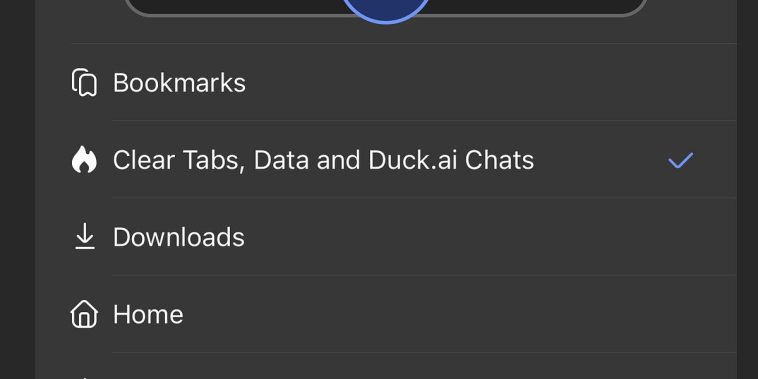
The plurality of our search traffic now comes from our own browsers. Yes, we have our own browsers with our search engine built in along with a ton of other protections. How do they compare to other popular browsers and extensions, you ask? We made a comparison page so you can see the differences. Our mobile browsers on iOS & Android launched back in 2018 (wow, that’s seven years ago), and our desktop browsers on Mac and Windows in 2022/23. Our iOS browser market share continues to climb and we’re now #3 in the U.S. (behind Safari and Chrome) and #4 on Android (behind Chrome, Samsung, and Firefox). People appreciate all the protections and the front-and-center (now customizable) fire button that quickly clears tabs and data in an (also customizable) animation of fire.
About 13% of U.S. adults self-report as a “current user” of DuckDuckGo. That’s way more than most people think. Our search market share is lower since all of those users don’t use us on all of their devices, especially on Android where Google makes it especially hard. Once you realize that then it is less surprising that we have the highest search market share on Mac at about 4% in the U.S., followed by iOS at about 3%. I’m talking about the U.S. here since about 44% of our searches are from the U.S., and no other country is double digits, but rounding out the top ten countries are Germany, the United Kingdom, France, Canada, India, the Netherlands, Indonesia, Australia, and Japan.
Our approach to AI differs from most other companies trying to shove it down your throat in that we are dedicated to making all AI features private, useful, and optional. If you like AI, we offer private AI search answers at duckduckgo.com and private chat at duck.ai, which are built-into our browsers. If you don’t like or don’t want AI, that’s cool with us too. You can easily turn all of these features off. In fact, we made a noai.duckduckgo.com search domain that automatically sets those settings for you, including a recent setting we added that allows you to hide many AI-generated images within image search. Another related thing you might find surprising is search traffic has continued to grow steadily even since the rise of ChatGPT (with Duck.ai traffic growing even faster).
If you didn’t know we have a browser, you probably also don’t know we have a DuckDuckGo Subscription (launched last year), that includes our VPN, more advanced AI models in Duck.ai, and in the U.S., Personal Information Removal and Identity Theft Restoration. It’s now available in 30 countries with a similar VPN footprint and our VPN is run by us (see latest security audit and free trials).
Speaking of lots of countries, our team has been completely distributed from the beginning, now at over 300 across about 30 countries as well, with less than half in the U.S. And we’re still hiring. We have a unique work culture that, among other things, avoids standing meetings on Wednesdays and Thursdays. We get the whole company together for a week once a year.
We played a critical role in the Global Privacy Control standard and the creation of search preference menus. I have a graduate degree in Technology and Public Policy and so we’ve done more of this kind of thing than one might expect, even going so far to draft our own Do Not Track legislation before we got GPC going. We also donate yearly to like-minded organizations (here’s our 2025 announcement), with our cumulative donations now at over $8 million. Check our donations page for details going back to 2011. We can do this since we’ve been profitable for about that long, and more recently have even started investing in related startups as well.
If this hodge-podge of stuff makes you think of anything, please let me know. I’m not only taking requests for easter-egg logo ideas, but also for stuff to write about.
Share





GIPHY App Key not set. Please check settings