 Mr Viral
No Oscar category showcases a broader creative spectrum than animation. Where else could a $10 million 2D philosophical French drama about death compete on equal footing with the sequel to a $1 billion blockbuster?
This year’s contenders for Best Animated Feature reach across genres, cultures and styles.
Neon’s hand-crafted Arco is a Hayao Miyazaki-style time-traveling fantasy about a boy from the future who travels on rainbows and offers humanity an alternative to climate change disaster. GKids’ intimate cross-cultural childhood drama Little Amélie or the Character of Rain, another 2D film, follows the internal life of a young Belgian girl growing up in post-war Japan. Among the studio titles, we have the noir-tinged crime tale of Disney’s marquee franchise sequel Zootopia 2 which returning us to the all-creature metropolis of the 2016 original, and the horror/sci-fi mash up of Pixar’s Elio, about a boy desperate to be abducted by aliens. Netflix this year delivered both the girl-power musical/action combo of global phenomenon K-Pop Demon Hunters, and the family fantasy of In Your Dreams about two kids who travel to dreamland in search for real-life solutions.
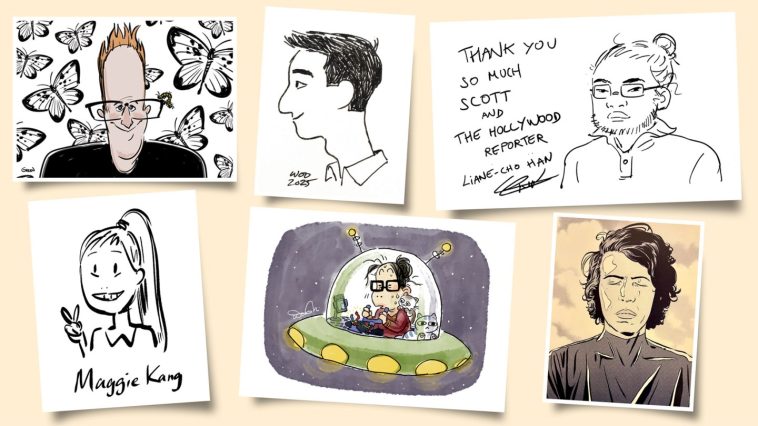
For THR‘s Animation Roundtable, the helmers of this awards season’s frontrunners — Arco director Ugo Bienvenu, Zootopia 2 co-director Jared Bush, Little Amélie co-director Liane-Cho Han, KPop Demon Hunters co-director Maggie Kang, Elio co-director Domee Shi, and In Your Dreams co-director Alex Woo — talk originality, shifting audience expectation and why, for animation, “nerd love” is not only tolerated but required.
What makes a great animated filmmaker?
LIANE-CHO HAN Patience.
MAGGIE KANG You have to be a super collaborator. You have to have a lot of stamina because it takes a while to make these.
DOMEE SHI You have to be slightly masochistic. It’s a painful and long process and you have to love it. You have to love the pain and the payoff of watching one beautiful second of animation that you’ve toiled for months over.
KANG Or years.
JARED BUSH I think you have to also love evolving a story. At least for me, you’re not coming in with a story that stays in the same place, but it’s this constant evolution that’s aided by all that collaborative help that you’re getting.
UGO BIENVENU Also, for me, it’s about knowing every field of the work. It’s good to know every part of the job so you can explain and help people work on it and find solutions.
KANG You also have to spin a lot of plates at the same time. Sometimes it’s, like, hundreds.
BUSH I think you also have to love animation. I mean, it seems like that’s an obvious thing, but I don’t know if that’s the case for everybody. I think you actually have to love the medium in order to be a successful filmmaker.
ALEX WOO Yeah, I totally agree. I was going to say that I think you have to be a real nerd about animation. You have to know the history of it. You have to know the technique of it, the craft of it, to really take advantage of everything the medium has to offer because it’s such an incredible medium. Having really deep nerd love for animation really helps when you’re directing.
Maggie, KPop Demon Hunters has become a cultural phenomenon across music, film and animation. But you spent a long time developing the project before Netflix came on board. What kept you going all those years developing this original, untested idea?
KANG Passion. I knew I wanted to see this movie, and that’s the thing that really drove me the entire time. You’re creating something out of nothing, which is, I think, the hardest thing to do as a human being. When you see it slowly come together and then you start to build a team that is helping you see this vision through, it just keeps fueling you no matter how hard it gets. You also don’t want to let your team down that’s putting all this love into something that you came up with.
Ugo, Arco is your first feature animation film. What was your personal connection to the story that made you want to take the leap?
BIENVENU I’ve been doing science fiction since 10 years, almost. And one day it appeared to me super clearly, “OK, we’re living in a bad science fiction movie.” And I thought, “It’s because mainly, we’re always telling a bad future story,” you know? And if we just imagine the worst, it’s just going to happen, because human beings have the ability of bringing to the world their ideas. I think if we want better things to happen, we have to imagine them first. That’s what gave me the will to do this movie.
Neon’s handcrafted dystopian hopeful Arco.
Remebers – MountainA
Jared, the world has changed a lot since the first Zootopia. One of its core themes — diversity — has become politicized. Did that influence how you approached the sequel?
BUSH It’s interesting. I’d say what we were really trying to do on the first film was to talk about human nature and how humans interact. Bias and stereotypes were major talking points, but those themes are evergreen. They would resonate 10, 20, 50 years ago and will into the future. For this story, we asked: How are we going to use these themes and evolve them so it feels like a continued conversation? We as humans make the same mistakes over and over — how do we talk about those?
Liane-Cho, Little Amélie is a really interesting story, about a Belgian girl growing up in Japan, very much a cross-cultural story. What was the emotional core of the story for you?
HAN It’s an adaptation of a book, which is quite famous in France. I discovered the book when I was 19, so more than 20 years ago. I was not really a bookworm at the time, I was more into pop culture, Japanese animation, video games. But I was so moved when I read that book, moved by this unique case of this 2½-year-old Belgian girl born in Japan who believes she’s God. What really moved me is the evolution of this girl from where she believes she’s God until she has this disillusion and understands that you cannot control everything but still love life. What really moved me was the relationship between Amélie and [her family’s Japanese housekeeper] Nishio-san.
Domee, with Elio, you came in as a co-director, with Adrian Molina and Madeline Sharafian, on a film already in development. Was it a challenge to make it your own?
SHI The original idea came from Adrian Molina, inspired by his childhood on a military base as the weird kid. When he stepped away for Coco 2, Madeline Sharafian and I were brought on to finish the movie. Then, with the strikes, the release moved, giving us more time. At Pixar, we take every second to improve.
Maddie and I examined Elio and tried to infuse him with a drive we related to: a desire to be abducted by aliens, to find a place where you belong. That came from our lives as weird kids dreaming of going to animation school and finding our tribe of nerds. It turned the movie into a wish-fulfillment story and let us subvert sci-fi tropes — like making the abduction scene joyful instead of scary.
Alex, you worked for several years at Pixar before setting up your own company, Kuku Studios. Why did you decide to set your feature debut, In Your Dreams, in the dream world, and what was the key to cracking the story?
WOO When we started our company in 2016, we spent a year dreaming up ideas we wanted to see. One was a dream-world animated movie. Everyone dreams across cultures and time, but nobody had done it yet. So it felt like a gold mine. But as we started developing, we quickly discovered why nobody had done it: Dreams make stakes hard. If anything can happen, nothing matters. So how do you give a dream movie stakes?
The key that unlocked the idea for us was what if our kids, Stevie and Elliot [voiced by Jolie Hoang-Rappaport and Elias Janssen], found the Sandman [and] he could make their dreams come true. Suddenly there was a connection between dream world and real world. But we still needed the core story. I drew from my childhood. When I was like 6 or 7 years old, I woke up one morning and my mom had packed her bags. She left for a little while. It was really scary for me and my brother. At that moment, all I wanted was to find a way to keep my family together and keep it whole. I told that story to my team and they were like, “That’s really juicy.” The combination of this fantastic adventure in the dream world with this really intimate story about a kid just trying to keep her family whole gave us the movie.
Jared, Domee — how open are the big studios to originals?
SHI It’s hard. Elio got massacred at the box office even though audiences who saw it loved it. The question is how to push original theatrical films through all the noise. I’m hopeful, though. Maggie’s film gives me hope.
KANG When you pitch, marketing gets involved immediately. What helped my film was the marketability of K-pop. I took that, this marketable idea, and then thought: I’m going to make the most Korean, personal movie I can out of what the world knows.
WOO Studios want sequels because they’re easier to market. With originals, you find a marketing hook. I think our marketing hook was dreams, that everybody dreams. I think that’s what kept the studio excited.
BUSH Sequels-only is not a long-term business plan. I think we all know that the studios that push originality are the ones that audiences remember. You need originals to surprise people. I don’t know anybody that doesn’t want to see something new, something that surprises them, because when you know this is going to happen and then this is going to happen, it’s not that engaging. But when you can get an original story from a distinct cultural and personal perspective, or situational perspective, that can translate.
KANG And literally every IP was once an original.
Ugo and Liane-Cho, you work in the European system, where the budgets are much lower for animation. But are there advantages creatively?
BIENVENU At first you do limit yourself because you know you won’t have the budget. But in the end you write whatever you want and [in France] you always have final cut. Which I know for U.S. filmmakers is a luxury. I built my own studio for this film so I could control everything — the craft, the writing, the production — and to protect the teams. There’s less money, yes, but also less economic pressure.
HAN We have public and private funding in our movie. It cost about 9 million euros [$10.4 million]. It takes longer to finance because you must convince many investors step by step. We faced challenges, because our book is for adults, but we wanted an intergenerational film. Everyone has an opinion about what kids can handle. It’s always a battle. The taboo around themes in children’s animation is huge even in Europe, where people say it’s too tough, children are too fragile.
Many of these films go places family animation rarely does. Domee, Elio uses almost horror themes. Was there pushback?
SHI I remember [Pixar chief creative officer] Pete Docter being a little concerned about the alien abduction scene. “Is that a little too intense?” We assigned that scene to a talented story artist, Le Tang. It wasn’t even fully scripted, just an outline, and Le knocked it out of the park in the first pass. We screened it, and everyone was laughing. Scared but in a fun way. So we kept going.
Maddie and I love sci-fi horror. We wanted a little John Carpenter, a little Ridley Scott. There’s a default in our films to aim for laughs or tears, but there are so many more reactions — tension, anticipation, squeamishness, cringe.
WOO That [alien abduction] scene was my favorite in the whole movie. The minute I saw it, I was like, “That is so Domee.”
Pixar’s sci-fi/horror mashup Elio and Netflix’s dream-world family odyssey In Your Dreams.
Disney/Pixar; Courtesy of Netflix
Are certain topics still taboo in animation? Are there places studios won’t go?
BUSH Honestly, no. People talk about that a lot, but since I’ve been here, I’ve only heard people say, “Push further.” Audiences like being challenged. The puzzle is: How do you reach a broad audience without diluting anything? You want parts that appeal to adults, parts that appeal to kids. It doesn’t mean every joke works everywhere — just that there’s candy for everyone.
HAN In our movie, we met taboos — especially around death. Our story deals with post-World War II Japan. It’s a hard topic. But kids can understand more than we think. There’s a scene where Amélie asks, “Why do we die?” That’s something my own son asked. He’s 6 years old. We didn’t make death violent, but we didn’t minimize it, either. We had to find the right balance.
BUSH At the core, we’re trying to make audiences feel something. Sometimes that means tackling difficult things.
KANG Every time I took a risk where I asked myself, “Is this too much?,” it was always the right choice. If you feel fear, lean into it.
BIENVENU Emotions are muscles. Stories help train those muscles so when real life happens, we don’t fall. This is why I think culture, books, films, stories, are so important for humans. Because you exercise your soul.
HAN A movie stays inside you because it left an emotional mark. That can shape who you become.
SHI No theme is taboo. It’s about execution. It’s not taboo to talk about grief, death, belonging, loneliness. It’s about how you do it and what makes it interesting. I think animation can have fun with all these genres, like the horror genre. We’re just scratching the surface.
Does that freedom now extend to animation style? 3D is still dominant in the U.S., but the two European films here are 2D. Is there more openness now to different forms of animation?
WOO I hope so. Anime’s rise gives me hope. Young audiences don’t see animation as a genre or as kids’ content. They know it can be mature, emotional, violent, whatever. In the West it’s slower, but it’s changing. Look at [Netflix’s adult animated show] Blue Eye Samurai.
KANG Yes!
WOO It gives me so much hope that a mainstream American animated show can look like that.
HAN And we’re the new parents. We grew up with all forms of animation — Japanese, French, American. So our kids will, too.
Netflix’s action-fantasy phenomenon KPop Demon Hunters, GKIDS’ intimate cross-cultural childhood drama Little Amélie and Disney’s marquee franchise sequel Zootopia 2.
Courtesy of Netflix; Maybe Movies, Ikki Films, 2 Minutes, France 3 Cinéma, Puffin Pictures, 22D Music; Courtesy of Disney
Jared, you’re working in an established Zootopia universe. Was it tricky to push the style?
BUSH Yes and no. I mean, obviously people want the characters to look like the characters. But for us, one of the most important things was to change the style in this movie so that we could try something new. We wanted something that felt much more noir, and we wanted to take advantage of what the story was — this is about these two characters who are figuring out their differences and compatibility. And that affected the visual language.
We’ve seen the new Sora 2 model come out, and OpenAI is now saying they’re backing an animated feature film that will cost $30 million and will deliver a $200 million-style animation. My question for all of you is: What are you afraid of, or hopeful for, in the use of AI in animation?
HAN I don’t know if this is the right answer, but when I was 20, my first animation teacher said to me: “Liane, don’t try to impress. Try to move people.” AI is impressive. But I don’t know if it can be moving.
BUSH That’s so well said. The thing I think is, human creativity is at the core of every movie. A movie is not one person voicing ideas into reality. It’s 700 people bringing their experiences and their perspectives. Those 700 points of view, what makes something profound, can’t be replaced.
KANG There’s a reason why our animators act out every scene. They record a reference video so that they can get into the character, feel it, and then be able to put that into the characters themselves. They need to be able to feel it to represent it onscreen. I don’t think AI can replicate that spark.
WOO Maybe I’m just being naive, but every time there’s been some sort of technological innovation in the arts, there’s always been a lot of fear around it. With CG [computer generation], people were like: “2D is going to die.”
Obviously there was a shift, but it’s still around. My film’s CG, but I hope there’s a lot of humanness in it. My hope is AI develops with artists, not instead of them. Art comes through people. Humans have a connection to something beyond themselves. AI won’t have that.
SHI Art is imperfect. Art is spontaneous. Art is unexpected. When you’re making a movie, you go down a path thinking something is wrong and discover it’s gold.
BUSH I don’t want AI to write my scripts for me. If I’m writing a script and my dog barfs on the floor and I have to stop writing, I’d like AI to come and clean up the barf so that I can continue to work on my stories.
If I can finish with a human question: What’s the one cinematic moment — from childhood or from your own work — that has stayed in your body, something you still carry with you?
SHI In Spirited Away, when Chihiro receives a rice ball from Haku and she starts eating it and crying and Joe Hisaishi’s piano music comes in — that makes me cry every single time. It’s so cute and sad and sweet and you really feel her loneliness. It’s a perfect scene.
HAN When I was 16, I discovered three movies. First Princess Mononoke. I watched it 12 times in one week. The same year I discovered Grave of the Fireflies. I spent an hour in my shower crying right after. Then I watched it five more times that week. And that same year I discovered Rurouni Kenshin: Tsuiokuhen [Rurouni Kenshin: Trust & Betrayal] — I think I watched it 50 times. At 16 you’re immature but also trying to build your identity. Those three movies really changed the course of my life.
WOO Grave of the Fireflies was mine. That can of hard candy that she had — I used to have that as a kid. Seeing that in the film devastated me. I couldn’t believe that movie was made. It’s a war movie about two kids just trying to survive the horrors of war. And then Iron Giant, the Superman moment when he goes up into the sky and takes the bomb — I was crying like a little baby. That stayed with me ever since.
BUSH I saw The Jungle Book in theaters — the first movie I remember seeing in a theater. It was experiencing joy. There is something about bringing joy to the world that is so critical. Animation is uniquely suited for that. Watching that movie for the first time and seeing a friendship start — that really stuck with me.
KANG When all the [Charlie] Chaplin films came out on DVD, my dad bought all of them and that’s all we watched all week. The one that really impacted me was City Lights. That last shot — just two close-ups of the blind girl, now no longer blind, and the tramp. Being able to feel all the emotions of these two characters in a silent film taught me so much about telling stories through pantomime and expression. Those two shots were one of my capsule moments — and that I shared it with my dad.
This story first appeared in a November stand-alone issue of The Hollywood Reporter magazine. To receive the magazine, click here to subscribe.






GIPHY App Key not set. Please check settings