 Mr Viral
When I think of America’s trajectory since the murder of George Floyd, I can’t help but hear in my head the lyrics from the Notorious B.I.G.’s 1994 hit “Juicy”: “It was all a dream.”
Five years ago this week, George Floyd—a part-time bouncer, rapper, and former high school athlete—was killed in broad daylight by Minneapolis police officer Derek Chauvin, who was later found guilty of murder. The slaying was captured in a cell phone video by a daring teenage onlooker named Darnella Frazier. She managed to keep her camera running for a harrowing 10 minutes, much of the recording showing Floyd being pinned to the ground, under Chauvin’s knee. The footage of Floyd, essentially narrating his own death, quickly went viral.
Jeanelle Austin, a community organizer, speaks at George Floyd Square on August 15, 2020 in Minneapolis, Minnesota. A community-led press conference was held to rebut the city of Minneapolis’ efforts to reopen the intersection of 38th Street and Chicago Ave without honoring a list of community demands.Getty Images.
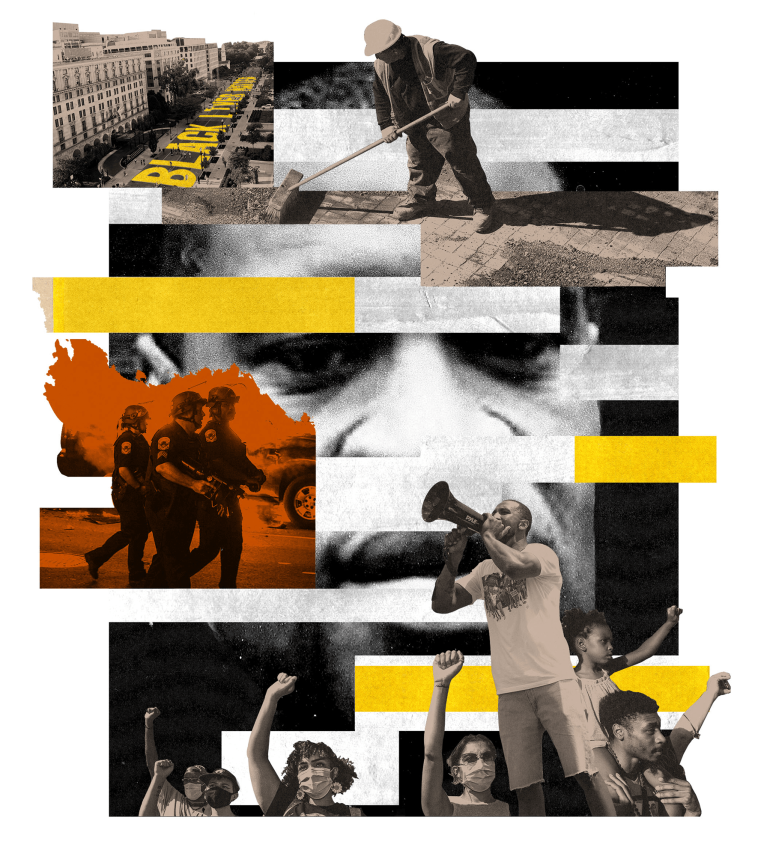
The protests that followed were overwhelmingly peaceful, interfaith, multiracial, intergenerational. The ripple effects from those demonstrations gave hope to millions, brought meaning to many, and spurred sweeping social action. As part of a national “racial reckoning,” corporations and academia rushed to make financial and structural commitments to bolster efforts supporting equity and justice. A long-observed holiday in the Black community, called Juneteenth, became a federal one. Arts spaces and the public square became even more fertile grounds for elevating too-little-discussed narratives of the experiences of communities of color.
But in the half decade since, America’s capacity to grapple with itself has swung widely from the arc of justice, to paraphrase Dr. Martin Luther King Jr., to a more cruel, divisive state of being. The US now seems to be at a juncture in its historical journey that calls to mind the gravest periods of the nation’s past.
Five years ago, just months into the pandemic, I allowed myself to hope. I allowed myself to believe that George Floyd’s death, and the widespread revulsion to it, somehow marked a turning point in the country’s centuries of struggle with race, identity, and belonging. The reality now is much more complicated, much more challenging. The bitter truth that has been gnawing at me and at so many Black Americans since May 25, 2020, is this: Social justice often moves at the speed and pleasure of whiteness.
Since European colonists first “settled” what was then Indigenous land, many Americans have tended to see more recent immigrants—at least those who happen not to be white—as the “other.” Still, a new kind of othering is rearing its ugly head. Even before the old-new administration returned to the White House, the commitments made by American business, philanthropy, and academia toward realizing Dr. King’s “beloved community” had begun to dissolve in the face of political intimidation and legal action.
The “Say Their Names” memorial installation at George Floyd Square in Minneapolis, Minnesota, on April 10, 2023.Getty Images.
Come 2025, daily reminders abound. International students enrolled in America’s institutions of higher learning are being arrested, detained, and threatened with being sent home—just for protesting what they consider to be an immoral conflict in the Middle East. Latine residents—including those who are, in too many cases, naturalized and birthright citizens—are being detained or deported without due process. They, too, to borrow from Langston Hughes, sing America. Perpetually under political assault, the LGBTQ+ community is bracing, again, to defend “marriage equality,” while trans youth and their families desperately scramble to receive and maintain requisite medical attention. And the recent acquittals of three Memphis Police Department officers charged in the 2023 death of Tyre Nichols—as well as last year’s acquittal of Daniel Penny for the chokehold strangling death of Jordan Neely on a New York City subway car—are yet another painful reminder that too easily, and too often, Black bodies can be sacrificed without accountability.
Communities of color and groups that identify as LGBTQ+ are feeling the heat of the backlash to “wokeness”; diversity, equity, and inclusion (DEI); critical race theory; and other grossly misrepresented terms that have been weaponized by the retributive forces in Washington, DC, and beyond. Too many people in the administration, in Congress, and on Main Street America now believe that previously understood remedies to address structural injustices are somehow manifestations of “reverse racism,” preventing a “true meritocracy,” one that might allow America to be “great again.” As a result, in the view of many on the far right, civil rights laws and policies enacted over the past 70 years must be suspended or reconsidered.
Last fall the Thurgood Marshall Institute’s Legal Defense Fund (LDF) released a report titled “What Project 2025 Means for Black Communities.” It examined the 900-page strategic plan incubated by the Heritage Foundation and intended as a blueprint for restructuring (indeed, de-structuring) the federal government. The study raised red flags about the social and economic risks posed by Project 2025 to Black Americans, but ultimately to all Americans. The LDF noted proposed staff cuts across the federal workforce, including to the Department of Education; the weakening of civil rights law enforcement by the Department of Justice; and the targeting of programs such as Head Start. Taken together, the LDF predicted, these initiatives would comprise a holistic assault on decades-long protections for “minority” and poor communities in the United States.
Donald Trump signed 143 executive orders in the first 100 days of his second term. Most hewed closely to the predictions of the LDF report and aligned with the priorities detailed in Project 2025. Within 48 hours of his inauguration, he signed an executive order that rid the federal government of all personnel working on DEI efforts, which, after George Floyd’s murder, had been elevated within the public and private sectors. The president halted the work of agencies overseeing environmental protections for communities of color and revoked a 1965 executive order, signed by Lyndon Johnson, that required equal employment opportunities for all. Now such programs are considered “illegal.”
Left: Workers continue to dismantle the Black Lives Matter Plaza street mural in Washington, D.C., March 11, 2025, a week after Mayor Muriel E. Bowser announced its “evolution”. The plaza was built during President Donald Trump’s first term, but a GOP Congressman introduced a bill threatening D.C.’s transportation funding if the mayor didn’t erase or rename it. Right: Crews use concrete saws, jackhammers, and excavators as they continue to dismantle the BLM Plaza street mural.Getty Images.
Historical memory, as well, is embattled. A Trump executive order has accused the Smithsonian’s 21 museums (including the National Museum of African American History and Culture, as well as the forthcoming American Women’s History Museum) of fostering “a sense of national shame” and disseminating “improper ideology.” What’s more, the head of the National Archives, Colleen Shogan, was dismissed and replaced by none other than Marco Rubio, who also holds the jobs of secretary of state, acting national security adviser, and head of USAID. Librarian of Congress Carla Hayden—the first woman and first Black American to hold the position—was sacked this month, learning of her firing in a two-line email.
In short, the Trump administration and the framers of Project 2025 have upended, one by one, each and every dream that Americans allowed themselves during the first flush of the Black Lives Matter–driven movement.
Was it all a dream?
By now, the public has had time to absorb the realities of these rollback efforts. Since the murder in Minneapolis, the views of Americans today are more nuanced when it comes to matters of race. Earlier this month, the Pew Research Center released “Views of Race, Policing, and Black Lives Matter in the 5 Years Since George Floyd’s Killing.” In that time, there has been a 15% decrease in support for the Black Lives Matter movement. At present, 49% of Americans are pessimistic about the prospect of Blacks achieving equality with their white counterparts. (That number stood at 39% in 2020.) Most people—72%—say that the increased attention to race, during a period of increased DEI efforts, didn’t improve the lives of Black Americans.
Amid the steady implementation of Project 2025’s priorities—and the government’s sanction of grievance-driven forces within the media, the political class, and the electorate—an ever-growing chorus of voices urges me to “keep my head down,” “not make any waves,” “stay under the radar.” To say the least, I am disappointed and saddened at the realization that most of my fellow Americans may not really understand or care what it means for a person of color to show up in the world each day, to look in the mirror, to retain hope and pursue dreams.
Protestors participate in the Hands Off! rally, a National Day of Action opposing Donald Trump’s slash-and-burn attacks on federal healthcare programs and government workers in April 5, 2025 in New York, NY.Getty Images.
Nonetheless, something has been stirring during the four months since the ascendance of MAGA 2.0, since the fracturing of the world order across so many systems. I see it in the virtual and IRL protests that have begun to emerge. In combative local town halls with elected officials. In the human blockades of buildings and roadways. In mega-rallies and marches. In the arrests of those who have mobilized against the detention of undocumented residents and their families. In scores of lawsuits being filed in state and federal courts. In the untold thousands who have stood up for friends and colleagues who have lost their jobs to DOGE’s unsparing scythe. And, of course, in innumerable behind-the-scenes attempts to counter Project 2025.
More than anything else, the national and global response to the murder of George Floyd reinforced for me the resolute power of shared humanity, of existing on common ground. And today, as new forces have amassed in backlash to that power, it is clear that the historically disenfranchised, the systematically oppressed, those dehumanized for their religious beliefs, the others, are slowly but surely beginning to forge alliances—with one another and with those willing to sacrifice their positions of power and comfort to provide support and aid, empathy and unity. Last month’s “Hands Off!” demonstrations, for example, spanned the artificial silos of identity across race, ethnicity, spoken language, age, and economic status.
We are in a period in which our ties are frayed or broken. Multiple, overlapping threats confront us all, whether we recognize them or not, and we have each sought solace or answers, retribution or protection, in our own corners, in our own way. This is why creating solidarity—and preserving credible narratives and histories—matters. Because it all illustrates our commonality and inspires connection rather than division.
All of it may have been a dream, but we need to wake up from the present nightmare and stand up—together.
Mariska Hargitay Was “Living a Lie” for 30 Years. Now She’s Embracing Her Mother—and Her Biological Father
Inside LA’s Young, Testosterone-Fueled Sperm Race
Molly Jong-Fast Reflects on Her Mother’s Dementia and the Fleeting Nature of Fame






GIPHY App Key not set. Please check settings